
Independent industry shortlist for Industrial Vacuum Cleaning Systems
Best Industrial Vacuum Systems for Combustible Dust 2026
Answer in brief
Ruwac, VAC-U-MAX, and Depureco make up this 2026 shortlist of industrial vacuum systems for combustible dust.
Ruwac covers Class I and Class II, Division 1 and 2 with ETL-certified electric machines and adds immersion separators for Group E metal dusts. VAC-U-MAX pairs ATEX-certified air-powered drum vacuums with explosion-proof electric units and central systems from 10 to 100 HP.
Depureco offers an ATEX range for Zones 21 and 22 from 1.1 kW portables to 25 kW fixed suction units.
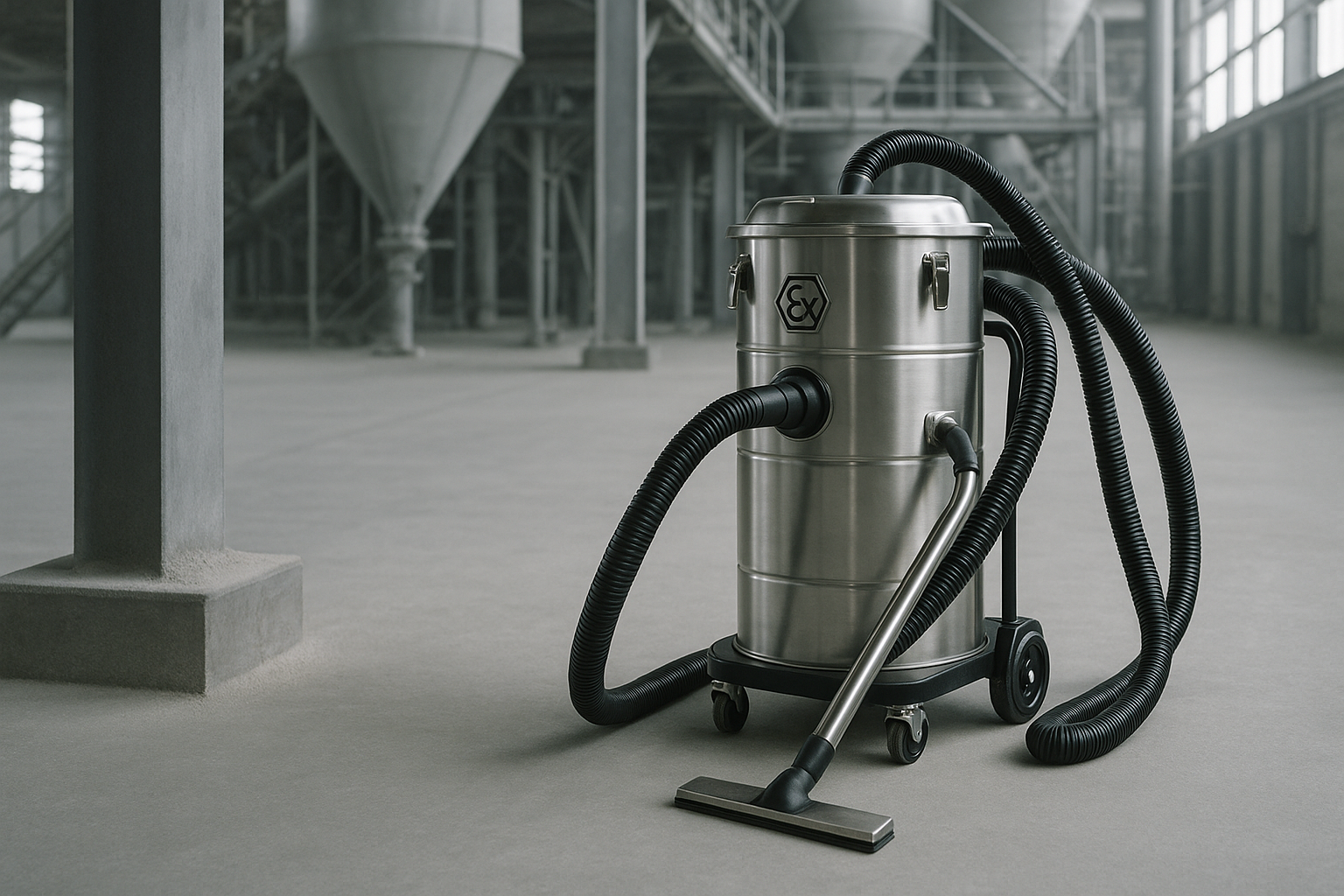
What separates these from an ordinary industrial vacuum is a rating that matches the classified area, plus grounded, static-dissipating construction from wand to filter.
By Editorial Team · Published August 14, 2026 · Updated October 14, 2026
How we selected these companies
ShowHide
We compared industrial vacuum suppliers on five technical areas that decide whether a machine can be used on combustible dust at all, and then how well it fits the plant. Only product lines built for combustible dust were compared; a general industrial vacuum range does not count.
- Hazardous-area certification (30%) looks at the classified areas a range is rated for: NFPA 70 Class, Division, and dust Group, ATEX zones and equipment marking, and third-party listing such as ETL to UL and CSA standards.
- Vacuum range and configurations (25%) looks at the spread of machines across portable, continuous-duty, and central formats, electric and air-powered, with their power, airflow, vacuum, and collection capacity.
- Dust types and applications (20%) covers the dusts and operations a range is built for, such as Group E metal powders, conductive IIIC dusts, and food or pharmaceutical powder rooms.
- Static control and filtration (15%) covers grounding and bonding, static-dissipating housings and filters, filter area and efficiency, HEPA stages, and immersion separation.
- Plant integration (10%) covers central and fixed installations, discharge options, and connection to process lines.
Certification carries the most weight because the rating has to match the area classification before any other property matters; range comes second because airflow and vacuum decide whether the machine can do the cleaning job.
Hazardous-area certification 30%
NFPA 70 Class, Division, and Group coverage, ATEX zones and marking, and third-party listing such as ETL to UL and CSA standards.
Vacuum range and configurations 25%
Spread of combustible-dust machines across portable, continuous-duty, and central formats, electric and air-powered, with power, airflow, and capacity.
Dust types and applications 20%
The dusts and operations a range is built for, from Group E metal and conductive dusts to food and pharmaceutical powder rooms.
Static control and filtration 15%
Grounding and bonding, static-dissipating housings and filters, filter area and efficiency, HEPA stages, and immersion separation.
Plant integration 10%
Central and fixed installations, discharge options, and connection to conveying and process lines.
Last reviewed October 7, 2026
Housekeeping is where most combustible-dust incidents are either prevented or primed. Layers of settled dust on beams, motors and floors are the fuel for the secondary explosions that destroy buildings — and the vacuum cleaner used to remove that dust is itself an ignition source if it was never designed for the duty.
An ordinary shop vacuum pulls a dust cloud through an electric motor with sparking brushes: exactly the combination the rest of the plant is engineered to avoid.
Why an ordinary industrial vacuum is not enough
A combustible-dust vacuum has to control every ignition source inside itself while it deliberately creates a dust cloud in its own separator. That means certified electrical components or no electrical components at all, conductive and grounded construction from the wand tip through the hose to the collection drum, static-dissipating filters, and motors that never contact the dust-laden airstream.
OSHA's Combustible Dust National Emphasis Program treats vacuuming with unapproved equipment in dusty areas as a citable condition, and the NFPA combustible-dust framework expects housekeeping equipment to be suitable for the classified area it serves.
Reading the certifications
Two systems dominate the labels. In North America, NFPA 70 (the National Electrical Code) classifies dust areas as Class II, with Division 1 for areas where combustible dust is present in normal operation and Division 2 where it appears only in upsets; combustible metal dusts add Group E, with Groups F and G covering carbonaceous and agricultural dusts.
In the ATEX system, Zones 20, 21 and 22 grade the same idea for Europe. A serious supplier states exactly which Class, Division, Group or Zone each model is certified for, and names the certifying body — an ETL or UL listing, or a notified-body ATEX certificate. "Explosion-proof style" wording without a stated scope is a warning sign, not a credential.
Electric versus air-powered
Certified electric vacuums carry classified-area motors and controls; they suit continuous housekeeping duty and central installations. Air-powered (venturi) vacuums remove the electrical question entirely — no motor, no brushes, no heat — and, when grounded and bonded, meet the intrinsically safe expectations of NFPA 77 for static control.
Their trade-off is compressed-air consumption. For Class II Division 1 areas and impact-sensitive metal dusts, air-powered designs with immersion separation are frequently the conservative choice; for Division 2 housekeeping over large areas, certified electric continuous-duty machines are usually more economical.
Portable, continuous-duty or central
Portable drum units handle spot cleaning and spill recovery. Continuous-duty machines run through whole shifts and feed recovered product back into the process. Central vacuum systems put the separator and exhauster outside the classified area, leave only grounded piping and inlet valves in the process space, and turn housekeeping into a permanent installation — the standard answer for large food and chemical plants with recurring dust loads.
The supplier question changes accordingly: a portable unit is a catalog purchase, a central system is an engineering project with duct design, isolation and discharge interfaces.
Filtration and discharge
Fine dust demands staged filtration — a primary separator or cyclone stage, static-dissipative main filters, and HEPA-grade final filtration where exposure or product recovery requires it. Discharge design matters as much: bag-in/bag-out or closed drum handling keeps the collected hazard contained, and for metal dusts, immersion (wet) separators quench glowing particles before they reach a dry filter bed. Every component in the dust path should be conductive or static-dissipative and bonded to ground.
How we ranked the suppliers
The ranking below weighs five technical properties. Hazardous-area certification comes first, because the rated Class, Division, Group, or Zone is the property a buyer cannot compromise on. Vacuum range, the dust types and applications served, static control and filtration, and plant integration follow.
Building the housekeeping program around the machine
The vacuum is only as effective as the program it serves. NFPA-aligned housekeeping plans define which surfaces are cleaned at which frequency, and they prohibit the classic shortcut: blowing dust down with compressed air, which converts a settled layer into an airborne cloud at exactly the wrong moment.
Vacuuming is the preferred method precisely because it captures dust without dispersing it — but that only holds when hoses reach every accumulation point, wands fit between equipment, and the machine is actually available on the floor instead of locked in a store room. Central systems answer the availability problem structurally; for portable units, the number of machines and their staging points is a design decision, not an afterthought.
What the machines cost — and what drives it
Certified combustible-dust vacuums cost a multiple of ordinary industrial machines, and the certification is the reason: classified-area motors, conductive components, static-dissipative filters and third-party listing all price in. Air-powered units shift cost from the purchase to the compressed-air bill, which matters for continuous duty.
Immersion separators for metal dusts add another step. The honest comparison is against the alternative: a single dust ignition traced to an unrated vacuum ends any savings discussion — which is why OSHA citations in dusty plants so often list housekeeping equipment first.
Specifying your own machine
- Dust hazard analysis current, and the area classification (Class/Division or Zone) written down?
- Dust type known — organic, metal (Group E), hybrid with solvent vapors?
- Model certification matches the area, the dust group and the duty cycle?
- Grounding and bonding concept documented, including hose and accessories?
- Filtration staged for the fines, with HEPA where exposure demands it?
- Discharge containment defined — closed drum, bag-in/bag-out, immersion for metals?
- Housekeeping frequency and reach decided: portable, continuous-duty or central system?
Partner with powderbulkvideos.com
Show your equipment where buyers compare suppliers.
Booked places and Featured Listings are limited to 40 percent of a Top List, clearly labelled and separate from the editorial ranking.
Selected companies
-
1Best for: ETL-certified electric and air-powered vacuums for Class I and II, Division 1 and 2, with immersion separation for Group E metal dusts
Ruwac
Ruwac
Ruwac builds electric and air-powered vacuums for classified areas.
- The electric Powerhouse EX series is ETL certified to UL and CSA standards for Class I, Division 1 and 2, Group D and Class II, Division 1 and 2, Groups F and G, with motors from 1.5 to 10 HP, 150 to 500 CFM, and a 24 gallon dustpan.
- For Group E metal dusts the MX360EX passes all intake air through a liquid bath ahead of a 44 sq ft hydrophobic filter and collects 12 gallons.
- Air-powered Powerhouse EX units deliver 150 or 280 CFM from 65 or 100 CFM of compressed air.
- Housings are static-dissipating fiberglass composite, and the 48 sq ft MicroClean filter is 99% efficient at 0.5 micron.
- Compact central systems reach 560 CFM at 15 HP.
View related CompanyTechnical score breakdown
- Hazardous-area certification
- 5/5 · ETL certification to UL and CSA standards for Class I, Division 1 and 2, Group D and Class II, Division 1 and 2, Groups F and G; the MX360EX adds Class II, Division 1, Group E, and the range is Zone 22 certified.
- Vacuum range and configurations
- 5/5 · Workhorse EX with 9 gallon and Powerhouse EX with 24 gallon collection from 150 to 500 CFM, air-powered units with 150 and 280 CFM, immersion separators, dust collectors, and compact central systems.
- Dust types and applications
- 4/5 · Immersion separators collect aluminum, titanium, magnesium, zirconium, and other volatile metal dusts; a compact Class II, Division 2 immersion model serves universities and laboratories.
- Static control and filtration
- 5/5 · Static-dissipating composite housing, a 25 ft grounding reel on air-powered units, liquid-bath separation of all intake air, and MicroClean filtration at 99% efficiency at 0.5 micron with optional HEPA and ULPA stages.
- Plant integration
- 4/5 · Compact central systems from 300 to 560 CFM with self-dumping containers and reclaim cyclones for continuous powder discharge, plus dust collectors with a point-of-source extraction arm.
-
Best for: ATEX-certified air-powered drum vacuums plus explosion-proof electric and central systems from 10 to 100 HP
VAC-U-MAX covers combustible dust with air-powered, electric, and central machines.
- The compressed-air CD Series is ATEX certified in 15, 30, and 55 gallon drum sizes, the 55 gallon unit with single or twin venturi, and uses no electricity.
- Companion FL and SR Series handle flammable liquids and submerged recovery, where reactive metal powder is collected under a level of fluid.
- Static control runs from metal tools and static-dissipative hose to a static-conductive filter, ground straps, and conductive casters.
- Electric options include a 5 HP explosion-proof NEMA 7/9 continuous-duty unit and continuous-bagging vacuums up to 8.5 HP and 390 CFM for Class II, Division 2.
- Central systems span 10 to 100 HP and clean three to twenty stations at once; the 1040PD serves Class I and Class II locations.
View related CompanyTechnical score breakdown
- Hazardous-area certification
- 4/5 · Third-party tested ATEX certification for the CD, FL, and SR Series, Class II, Division 2 for the air-powered drum models and continuous-bagging units, a NEMA 7/9 explosion-proof electric unit, and a central system for Class I and Class II locations.
- Vacuum range and configurations
- 5/5 · Air-powered drum vacuums in 15, 30, and 55 gallon sizes, explosion-proof electric units, continuous-bagging vacuums in 2.5, 5, and 8.5 HP, and central systems from 10 to 100 HP.
- Dust types and applications
- 4.5/5 · Combustible dusts, flammable liquids, reactive metal powders from 3D printing, and propellants; in a feed mill a 15 HP unit moves 10,000 lb of powder an hour from 30 ft away.
- Static control and filtration
- 4.5/5 · Grounded and bonded air-powered design with static-dissipative hose, static-conductive filter, ground straps, and conductive casters; submerged recovery renders powders inert under fluid; PTFE-coated primary filter with HEPA secondary on the bagging units.
- Plant integration
- 4.5/5 · Central systems for three to twenty stations and up to six tons of material per hour; the 1040PD runs 1 to 3 operators on piping up to 200 ft and stays under 8 cubic feet of dirty volume.
-
3Best for: Third-party ATEX-certified DEX range for Zones 21 and 22, from 1.1 kW portable units to 25 kW fixed suction units
Depureco
Depureco
Depureco's DEX range carries third-party ATEX certification for dust Zones 21 and 22 with a dust chamber built to Zone 20, marked II 1/2D Ex h IIIC for conductive dusts.
- It starts with the brushless BL PRO DEX at 1.1 kW, 220 m3/h, and a 45 liter container, moves through the 65 liter ECOBULL DEX from 1.8 to 4 kW, and ends with the PUMA DEX at 7.5 to 18.5 kW, up to 1350 m3/h, and 175 liters.
- Class M antistatic polyester filters are standard, H14 absolute filters are fitted or optional, and containers are AISI 304.
- The compressed-air AC model reaches 480 m3/h at 500 mbar for Zones 2 and 22.
- Fixed CVS suction units from 11 to 25 kW pair with DV AIR filter units for centralized systems.
View related CompanyTechnical score breakdown
- Hazardous-area certification
- 4.5/5 · Third-party ATEX certification marked II 1/2D Ex h IIIC for Zones 21 and 22 with a Zone 20 dust chamber, and 3G IIB T3 marking for gas Zone 2 on the compressed-air and TX models.
- Vacuum range and configurations
- 5/5 · Brushless 1.1 kW portable units, side-channel machines from 1.8 to 18.5 kW with 45 to 175 liter containers, a Venturi compressed-air model, and fixed CVS suction units from 11 to 25 kW.
- Dust types and applications
- 3.5/5 · Combustible, conductive, and fine IIIC dusts, powders, solids, and shavings; a centralized system in a ceramics plant serves more than 40 suction points.
- Static control and filtration
- 4/5 · Complete grounding, antistatic polyester class M filters, H14 absolute filtration, AISI 304 containers with metal handles, and a pressure relief valve on every unit.
- Plant integration
- 4.5/5 · CVS units with 550 to 2100 m3/h feed multi-point piping; DV AIR filter units offer rotary valve or double butterfly discharge, flameless vent, vent panel, and non-return valve.
Frequently asked questions
What makes an industrial vacuum safe for combustible dust?
Certification for the classified area it works in, either NFPA 70 Class II Division 1 or 2 (Groups E, F, G) or ATEX Zones 20 to 22. On top of that it needs grounded, conductive construction through the entire dust path, static-dissipating filtration, and either classified-area electrics or fully air-powered operation with no electrical components at all.
Can I use a regular shop vacuum for combustible dust?
No. An ordinary vacuum pulls the dust cloud through an unrated electric motor with sparking brushes and past ungrounded plastic components, which makes it an ignition source by design. OSHA guidance on combustible dust calls for vacuum cleaners approved for dust collection and for cleaning methods that do not generate dust clouds.
Are air-powered vacuums better than electric ones for explosive dust?
Air-powered venturi vacuums have no motor, no brushes, and no heat source, and when grounded and bonded they meet the NFPA 77 expectations for static control. Their cost is compressed air: a unit delivering 150 CFM of suction can need 65 CFM of air at 71 PSI. Certified electric machines suit continuous duty and central systems, where that air consumption would be uneconomical.
When is an immersion separator needed?
For Group E metal dusts such as aluminum, titanium, magnesium, and zirconium, and for glowing or impact-sensitive material. An immersion separator passes all intake air through a liquid bath so particles are wetted and neutralized before they reach the filter. Dry collection of these dusts leaves a reactive deposit in the filter and drum.
What is a central vacuum cleaning system?
A permanently installed system with grounded piping and inlet valves in the process area, and the separator, filter, and exhauster located outside the classified zone. Central systems range from compact units for one to three operators to installations of up to 100 HP or twenty cleaning stations, and they keep the collection and discharge point out of the hazardous area.
How is the order of this list decided?
The ranked positions follow the five technical criteria: hazardous-area certification, vacuum range and configurations, dust types and applications, static control and filtration, and plant integration, weighted 30, 25, 20, 15, and 10 percent. Booked and Featured places are labeled as such and carry no rank.
Sources and further reading
- ATEX and explosive atmospheres, Health and Safety Executive
- Combustible Dust in Industry: Preventing and Mitigating the Effects of Fire and Explosions, Occupational Safety and Health Administration
- Combustible Dust Safety and Health Topics, OSHA
- Combustible Dust: Standards, Occupational Safety and Health Administration
- CSB – Combustible Dust Hazard Investigations, U.S. Chemical Safety and Hazard Investigation Board
- Directive CPL 03-00-008: Revised Combustible Dust National Emphasis Program, Occupational Safety and Health Administration (OSHA)
- Industrial Vacuum Cleaners Receive ATEX Certification, Pharmaceutical Technology
- New NFPA Consolidated Standard for Combustible Dusts, Exponent
- NFPA 652 – Standard on the Fundamentals of Combustible Dust, National Fire Protection Association
- NFPA 660, Standard for Combustible Dusts and Particulate Solids, National Fire Protection Association
- NFPA 660: Now the Only NFPA Standard for Combustible Dusts, Powder & Bulk Solids
- The Wrong Vacuum Can Become the Ignition Source, BulkInside
- VAC-U-MAX combustible dust air vacuums, ISHN
- VAC-U-MAX compressed-air industrial vacuum cleaners, ISHN
- What is NFPA 660 Standard for Combustible Dusts and Particulate Solids?, Processing Magazine
Related content
Continue exploring
Move from this page to the companies, videos and technical topics that add useful context.
Videos


VAC-U-MAX
VAC-U-MAX: Model 1050 Continuous-Duty Industrial Vacuum Cleaner
This VAC U MAX video explains the Model 1050 portable continuous duty vacuum system for dense material recovery. It helps define the system boundary and major components. Capacity, filtration, pressure loss, discharge and combustible dust suitability depend on the material and complete installation.
Total reach: 46,353

Ruwac
Customized Industrial Vacuums: The RUWAC R03 R
Ruwac presents the R03 R as an example of a customized industrial-vacuum configuration.