
Application
Dense Phase Conveying of Fragile Food Products
Answer in brief
In food plants dense phase conveying is chosen to protect the product.
Low velocity keeps coated snacks, instant powders and pre blended mixes intact, which is worth more than the energy it saves. Attrition rises steeply with velocity, so the gain from halving the speed is much larger than half.
- Match the velocity to the fragility, not to the distance.
- Watch blend segregation as well as breakage.
- Design the line to be cleaned, because it is a food contact surface.
Reviewed October 21, 2026
The problem
A dilute phase line moves product at twenty to thirty metres a second in suspension, and every bend is an impact at that speed. Coated snacks lose their coating, agglomerated instant powders are ground back into primary particles, extruded shapes break, and the fines that result change dispersibility, appearance and sometimes the declared particle size.
The damage is not linear with velocity. It rises steeply, which is why a modest reduction in speed produces a large reduction in breakage, and why velocity rather than route length is the design variable.
Pre blended mixes have a second problem. A long suspension flow sorts the components by size and density, so a blend that left the mixer uniform arrives at the packer stratified, and that happens without any visible damage at all.
Finally the line is food contact surface. Every metre of it, every bend, every joint and every valve has to be cleanable to the plant standard, and on a shared line it has to be cleanable to the allergen standard.
Desired outcome
A conveying line whose velocity stays below the damage threshold the product shows in a trial, from the start of the line to the end of it, with the rise in velocity along the line taken into account rather than ignored.
A blend that arrives as it left, which for a sensitive mix usually means dense phase rather than a longer mixing time or a tighter specification.
A line that can be cleaned to a defined standard, with the method written and the shared line entered in the allergen matrix.
For plastic pellets the same velocity question appears as smearing: angel hair is made in the line, and it is not a filter or a screen problem.
Process approach
The work begins with a conveying trial, because fragile food products are not predictable from a datasheet. The trial establishes two numbers: the rate the material will carry in dense phase, and the velocity at which damage starts. The second becomes the design limit for the whole line.
That limit then has to hold along the pipeline, which is the detail most often missed. Air expands as the pressure falls towards the receiving end, so the velocity at the last bend is far higher than at the first. A stepped pipeline, increasing in diameter in one or two stages, keeps the end of the line inside the limit, and without it the final bends do most of the damage.
Plug or moving bed behaviour depends on the material. Permeable granular products move as plugs, sometimes with air boosters along the line to keep the plugs short; fine air retentive powders move as a fluidised bed. Which one applies is a measured property, not a preference.
The line is then detailed for cleaning: crevice free joints, bends that can be inspected or removed, no dead legs at branches, and a cleaning method that somebody has written down and verified.
- Conveying trial to establish both the achievable rate and the damage onset velocity.
- Damage onset velocity adopted as the design limit for the whole line.
- Stepped pipeline so the velocity at the final bends stays inside the limit.
- Plug or fluidised behaviour determined by measurement, with boosters where plugs need breaking.
- Crevice free joints, removable or inspectable bends and no dead legs at branches.
- Shared line entered in the allergen matrix with a verified cleaning method.
Selection factors
- Fragility of the product and the fines increase that is acceptable, both measured rather than estimated.
- Blend composition and its segregation behaviour, where a mix rather than a single product is conveyed.
- Permeability and de aeration rate, which decide whether plug or fluidised dense phase applies.
- Cleaning method and frequency, and whether the line can be dried after a wet clean.
- Allergen matrix where lines are shared between recipes.
- Dust explosion characteristics of the product, including the fines the line itself creates.
Common failure modes
- Velocity limit set at the start of the line and exceeded at the end as the air expands
- Straight pipeline used where a stepped one was needed, so the last bends do most of the damage
- Dense phase specified without a conveying trial, on a material that will not form a stable plug
- Pre blended mix conveyed in dilute phase and found segregated at the packer
- Dead leg at a branch holding product through a changeover
- Fines increase measured at commissioning and never again, so wear induced damage goes unnoticed
Partner with powderbulkvideos.com
Put a relevant technical solution in this decision path.
Connect your company and video evidence with clearly labelled visibility where engineers evaluate this material, application, industry or product.
Frequently asked questions
Why is velocity more important than distance?
Because attrition rises steeply with velocity while distance adds damage roughly in proportion to the number of impacts. Reducing speed buys far more than shortening the route.
What is a stepped pipeline for?
To keep velocity down at the end of the line. Air expands as pressure falls, so the final bends run much faster than the first ones unless the pipe diameter increases in one or two stages.
Does dense phase help with blend segregation?
Yes, substantially. Material moving as a slow bed or in plugs is not sorted the way a suspension is, so a sensitive pre blend arrives much closer to how it left the mixer.
Related content
Continue exploring
Move from this page to the companies, videos and technical topics that add useful context.
Companies

Videos

Hosokawa Solids Solutions GmbH
Hosokawa Solids Solutions: Solids Puls Pneu Conveying System
Hosokawa Solids presents the Solids Puls Pneu plug-conveying system with bypass, impulse-valve and relay-station components.
Total reach: 70,558
Magnum Systems
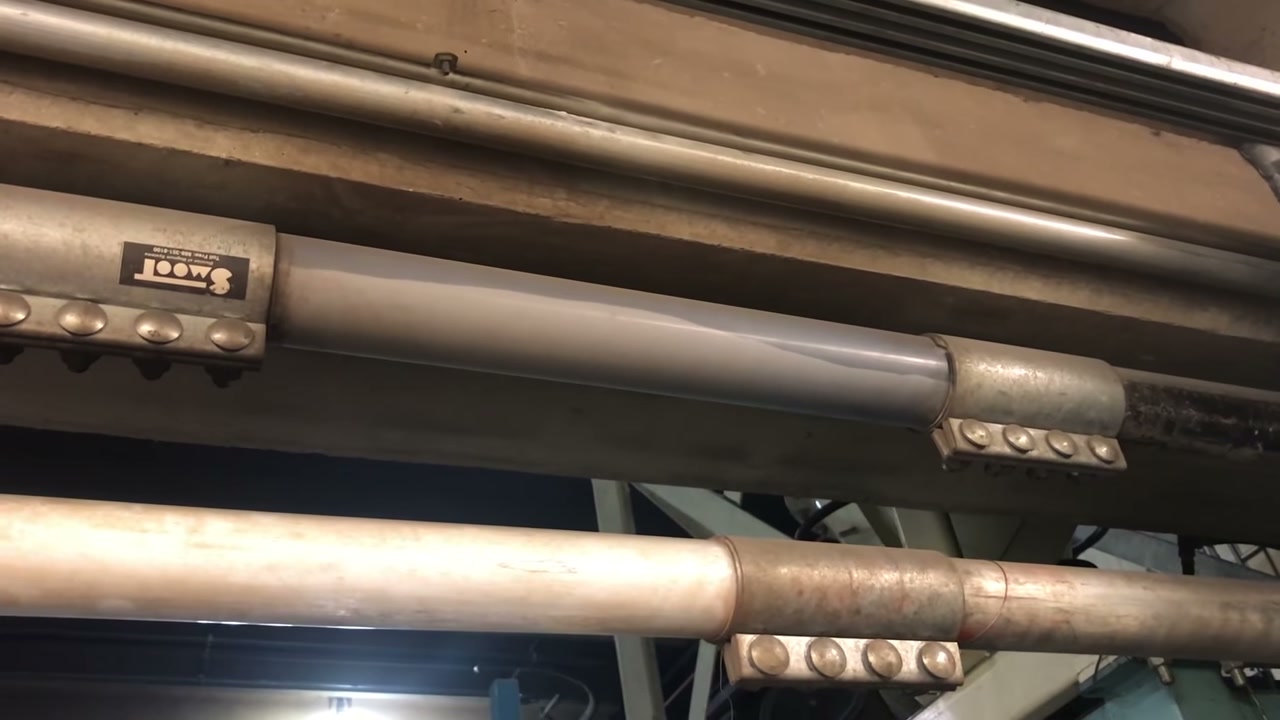
Dense Phase Conveying in the Test Laboratory
Magnum Systems shows dense phase pneumatic conveying running in its test laboratory in Kansas City.

Coperion
E-finity Continuous Dense Phase Conveying
Coperion presents E-finity, a continuous dense phase conveying system for fragile granular and pelleted materials that monitors pressure and corrects the airflow during the run.
Total reach: 1,905