
Application
Loss-in-Weight Feeding of Fragile Materials
Answer in brief
Feed fragile materials with the gentlest device that meets the rate — vibratory trays or large, slow screws with generous clearances — run at the lowest workable speed, refilled by low-energy transfers, and verify attrition with sieve or dissolution tests at commissioning. Accuracy tuning comes second: broken product measured precisely is still broken product.
Reviewed August 14, 2026 · Updated October 14, 2026
The problem
Desired outcome
Process approach
Selection factors
Common failure modes
- Screw speed chosen for rate headroom grinds the product at the tip clearances.
- Aggressive hopper agitation kneads agglomerates back into powder.
- Refill drops accelerate product onto bare steel and shatter granules.
- Fines from attrition change bulk density, so the volumetric bridge drifts over the campaign.
- Dilute-phase refill conveying destroys the product before the feeder ever sees it.
- Attrition is never measured, so the damage is discovered downstream as a quality complaint.
Partner with powderbulkvideos.com
Put a relevant technical solution in this decision path.
Connect your company and video evidence with clearly labelled visibility where engineers evaluate this material, application, industry or product.
Frequently asked questions
Which feeder type is gentlest for fragile products?
Vibratory tray feeders move product with almost no shear and suit granules and friable agglomerates best. Where screws are needed for rate or control, large slow single screws or twins with generous clearances beat small fast screws — attrition tracks tip speed and clearance pinch points.
How do I measure whether a feeder damages my product?
Sample before the feeder and after it, then compare: sieve analysis for size distribution and fines, dissolution or dispersion tests for instantized products. Run the comparison at commissioning across the operating range and write the acceptance numbers into the purchase.
Why do fragile products lose accuracy over a campaign?
Attrition creates fines, fines change bulk density and flow behavior, and the volumetric refill bridge drifts with them. Controlling breakage is therefore an accuracy measure, not just a quality one.
Does the refill path matter as much as the feeder?
Often more: a dilute-phase conveying line or a two-meter drop onto steel can destroy more granules than the feeder ever will. Dense-phase conveying, cushioned drops and product-on-product impact protect the material before it reaches the metering zone.
Related content
Continue exploring
Move from this page to the companies, videos and technical topics that add useful context.
Companies

Videos
Coperion
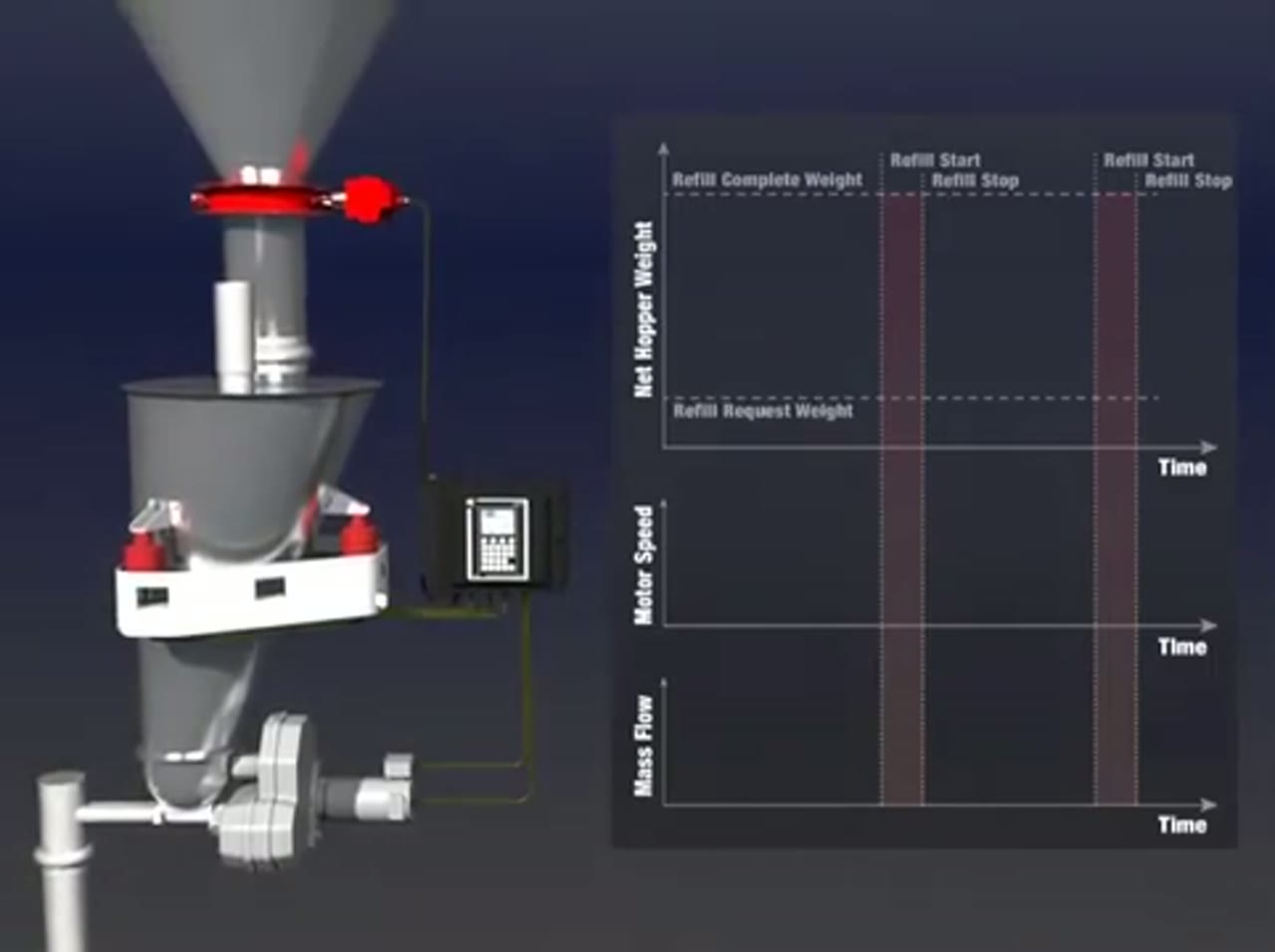
Coperion Loss-in-Weight Feeder Animation
The Coperion K-Tron animation shows a controller observing the decrease in combined hopper, feeder and material weight, comparing the measured rate with the setpoint and adjusting feeder output.
Total reach: 43,080

Volkmann GmbH
Product feeding of bagged goods (pellets)
Official Volkmann footage of bagged plastic pellets being fed into a vacuum conveying system. The clip documents one bag-feeding and vacuum-transfer boundary; suitability for a specific resin, additive package or receiving process must still be verified.
Total reach: 23,426