Skip to content
powderbulkvideos.com
Menu

powderbulkvideos.com knowledge hub

Powder and Bulk Solids Applications

In brief

An application is a job, not a machine.

Each page here takes one job in one industry, explains what makes it difficult, and shows which equipment combinations solve it.

  • The job defines the duty, the material defines the limits.
  • Most jobs are solved by two or three machines working together, not one.
  • The same job in food and in cement needs different answers.

Browse applications

127 published

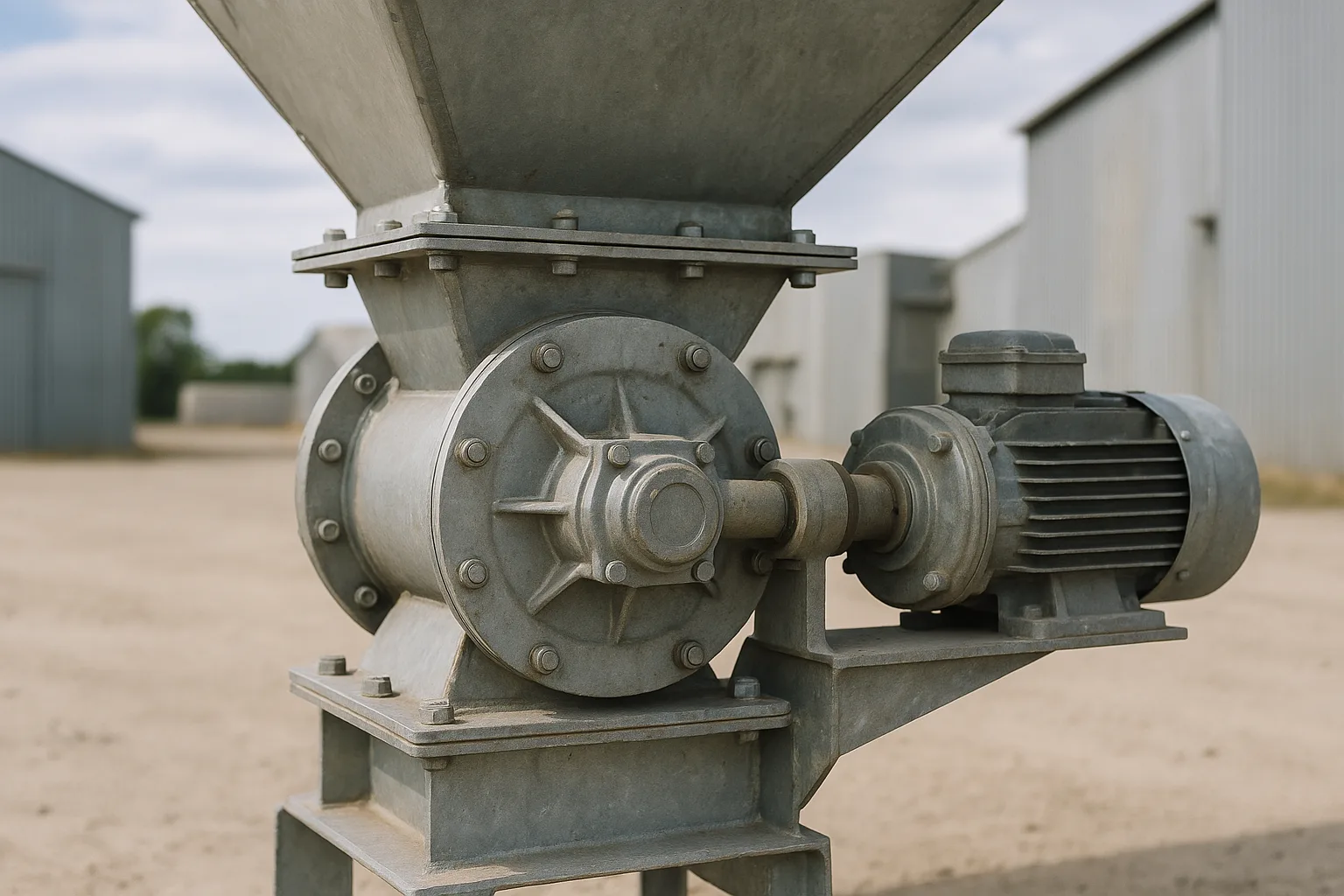
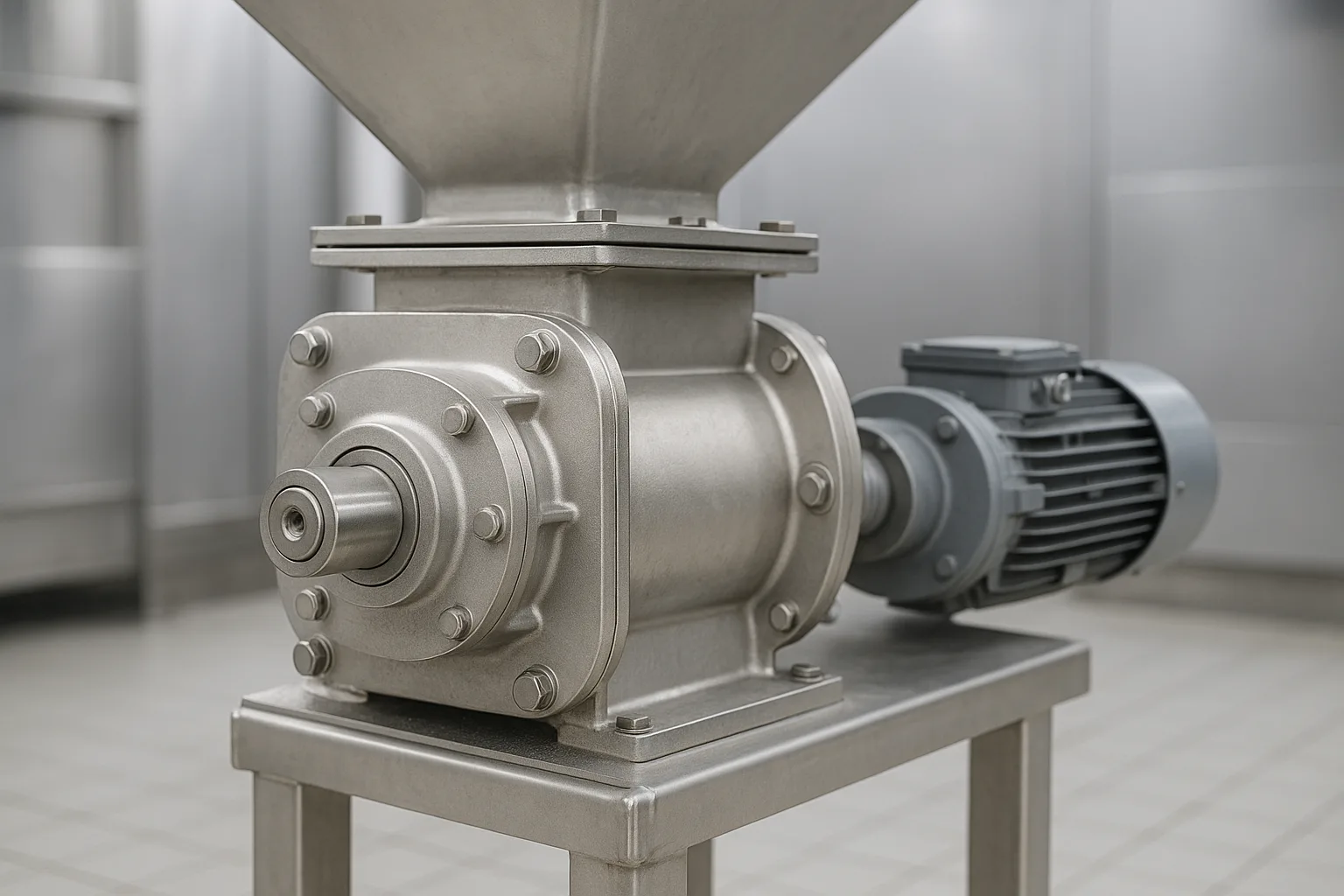
A rotary valve bolted under a hopper outlet, drive and bearing visible on one side.

Application

Hygienic Shut-off at Bin Outlets in Food Plants

A gate under a food bin has two jobs: hold the product back and leave nothing behind when the recipe changes.

A blade that passes through a settled bed drags product into the seat, and that seat is exactly where the next allergen comes from.

Explore
Photorealistic industrial process installation representing Hygienic Vacuum Conveying.

Application

Hygienic Vacuum Conveying for Food and Pharma

In food and pharmaceutical plants, vacuum conveying has to be designed around contamination control, inspection and cleaning, not just conveying capacity.

Product-contact materials, surface condition, seals, filter access, retained powder and cleaning validation decide whether the system can be cleaned reproducibly and released back to production.

Explore
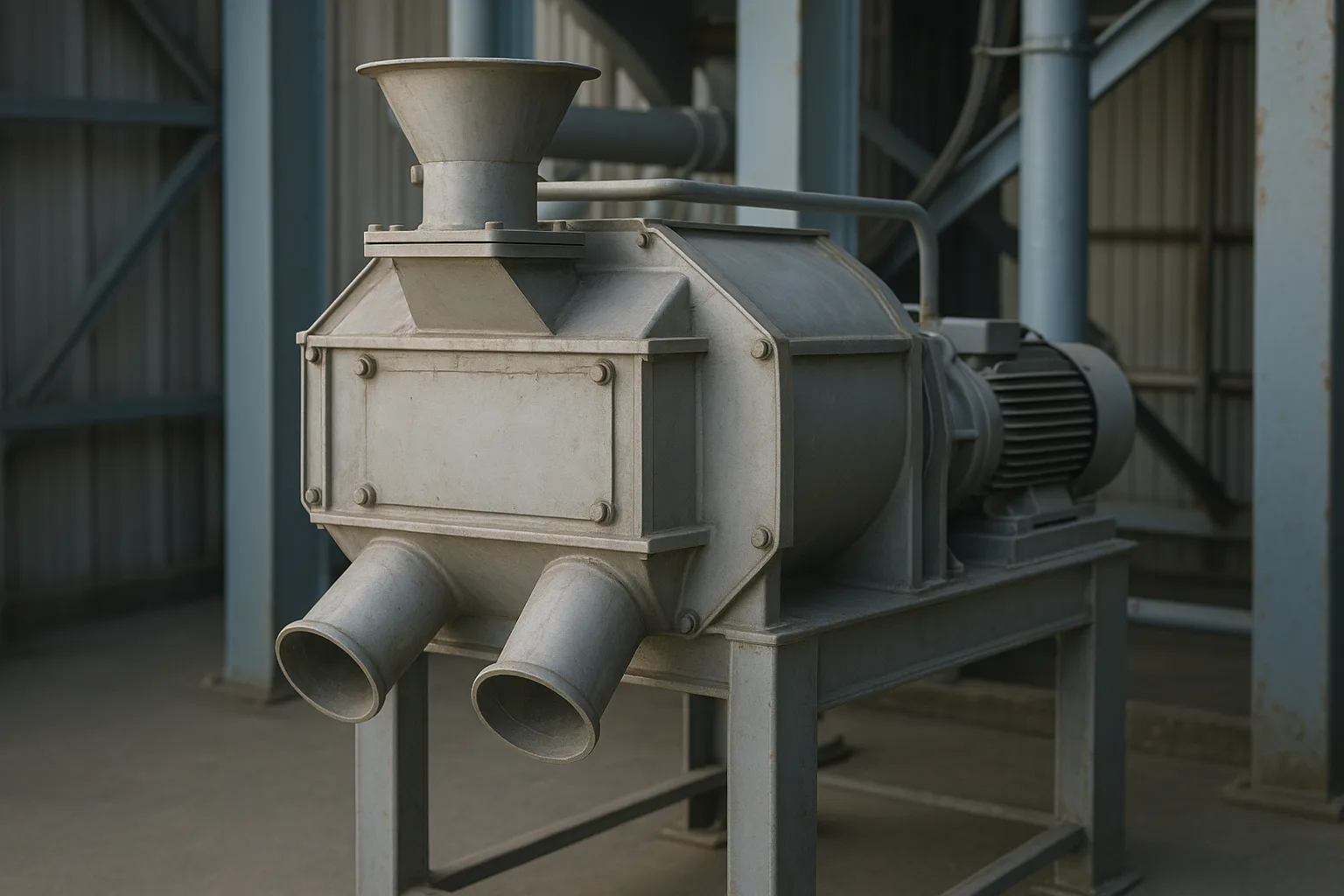
A centrifugal sifter with its feed inlet above and two outlets below.

Application

Inline Screening in Conveying and Processing Lines

Screen inside the line with an in-line centrifugal sifter: mounted in the conveying route or under the receiver, it checks product at full rate in an enclosed housing, discharges oversize through a separate contained port and preserves the line's vacuum or pressure regime.

The result is foreign-material control without breaking containment or adding a transfer step.

Explore
A rotary valve bolted under a hopper outlet, drive and bearing visible on one side.

Application

Intake Pit and Bin Gates in Grain Handling

In grain handling the gate is tied to the most dangerous task on the site: entering a bin.

A gate that cannot be proven closed and locked leaves a person standing on grain that can start moving.

Explore
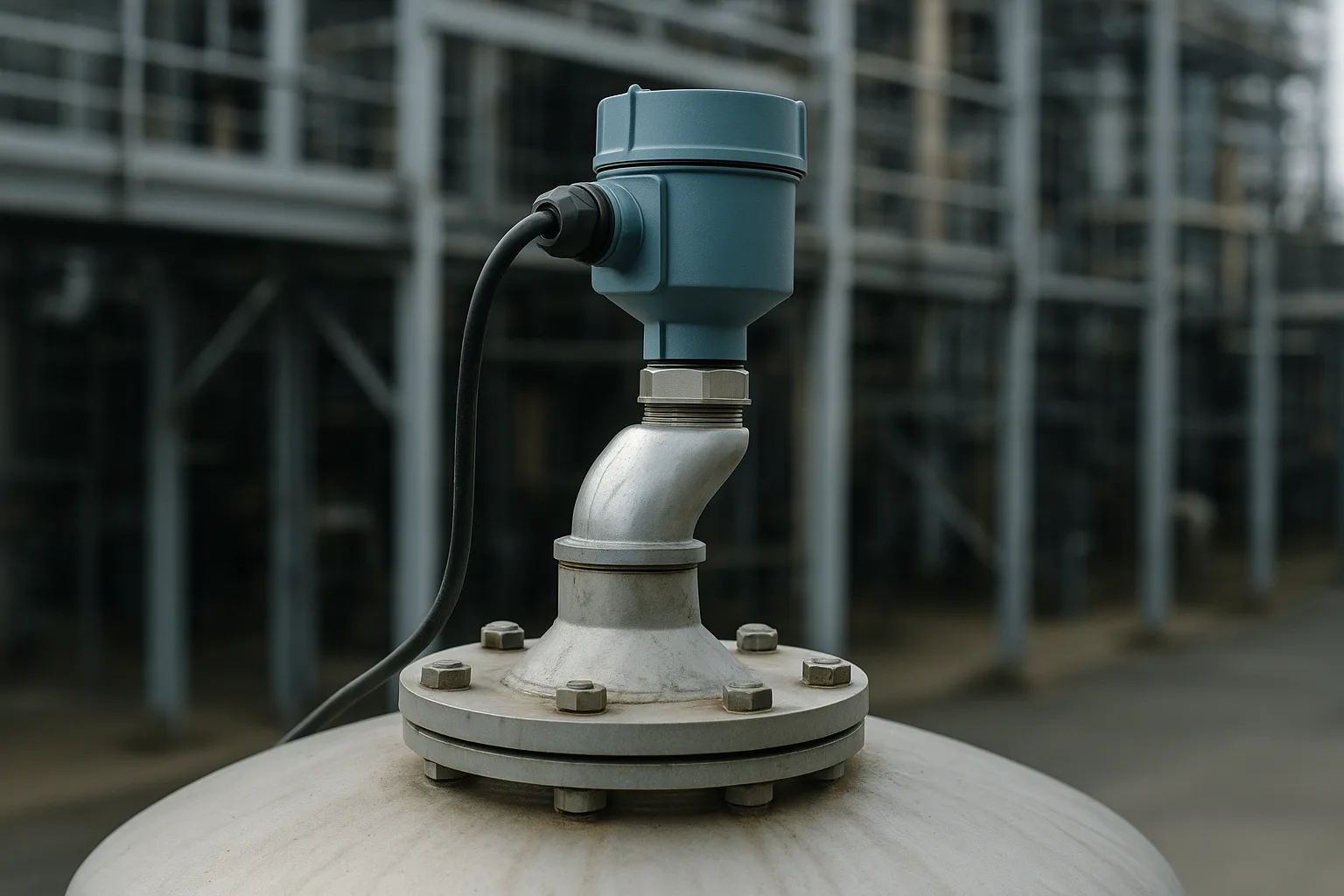
A radar level sensor mounted on the roof nozzle of a single outdoor silo.

Application

Level Measurement and Inventory Control in Chemical Plants

In a chemical silo the measurement has to survive the filling, the dust and the chemistry.

Ultrasonic measurement fails during pneumatic filling, and a low dielectric powder reflects radar weakly, so the sensor has to match the material.

Explore
A loss-in-weight feeder, its hopper standing on load cells, discharging through a short screw into the inlet below.

Application

Loss-in-Weight Feeding of Fragile Materials

Feed fragile materials with the gentlest device that meets the rate — vibratory trays or large, slow screws with generous clearances — run at the lowest workable speed, refilled by low-energy transfers, and verify attrition with sieve or dissolution tests at commissioning.

Accuracy tuning comes second: broken product measured precisely is still broken product.

Explore
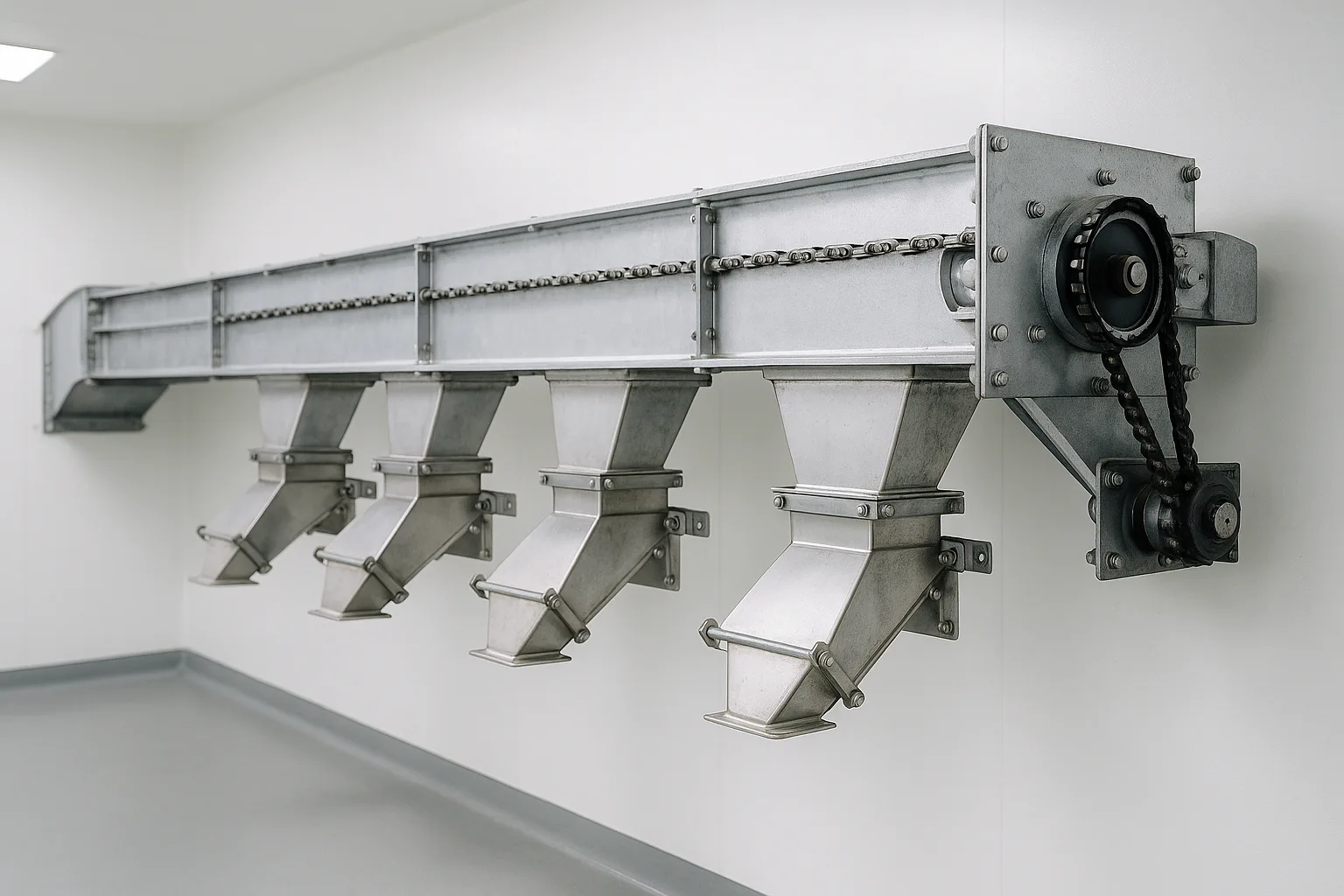
An enclosed chain conveyor running horizontally above a row of outlet gates.

Application

Mechanical Conveying in Battery Material Plants

In battery material production mechanical conveying is used sparingly, because every moving part in the product path is a contamination source.

Where it is used, the conveyor is fully enclosed, its contact materials are chosen against the chemistry, and wear is treated as a quality risk.

Explore
An enclosed chain conveyor running horizontally above a row of outlet gates.

Application

Mechanical Conveying in Chemical Plants

In chemical production a mechanical conveyor is chosen for enclosure as much as for transport.

A tubular screw keeps an aggressive or dusty powder inside a pipe, which is often worth more than the capacity advantage of an open belt.

Explore
A loss-in-weight feeder, its hopper standing on load cells, discharging through a short screw into the inlet below.

Application

Mechanical Conveying in Grain and Feed Handling

Grain handling uses mechanical conveying almost exclusively, and the equipment is as old as the industry and as dangerous as it has always been.

The conveyor and the elevator generate dust, enclose it and provide ignition sources, which is the complete recipe.

Explore
An enclosed chain conveyor running horizontally above a row of outlet gates.

Application

Mechanical Conveying in Pharmaceutical Production

Pharmaceutical plants use mechanical conveying sparingly, and the reason is cleaning.

Every flight, bearing and seal is a surface that has to be cleaned and proven clean, which is why closed vacuum transfer dominates in this environment.

Explore
An enclosed chain conveyor running horizontally above a row of outlet gates.

Application

Mechanical Conveying in Plastics Processing

In plastics the mechanical conveyor is chosen to avoid what pneumatic transfer does to pellets.

No high velocity means no angel hair and no fines, but a screw brings its own shear, so the choice depends on the product rather than on preference.

Explore
An enclosed chain conveyor running horizontally above a row of outlet gates.

Application

Mechanical Conveying in Power and Fuel Handling

A fuel conveyor carries material that can burn while it is moving.

Spillage, carryback and dust layers around the conveyor are not housekeeping issues here; they are the fuel for the next incident.

Explore
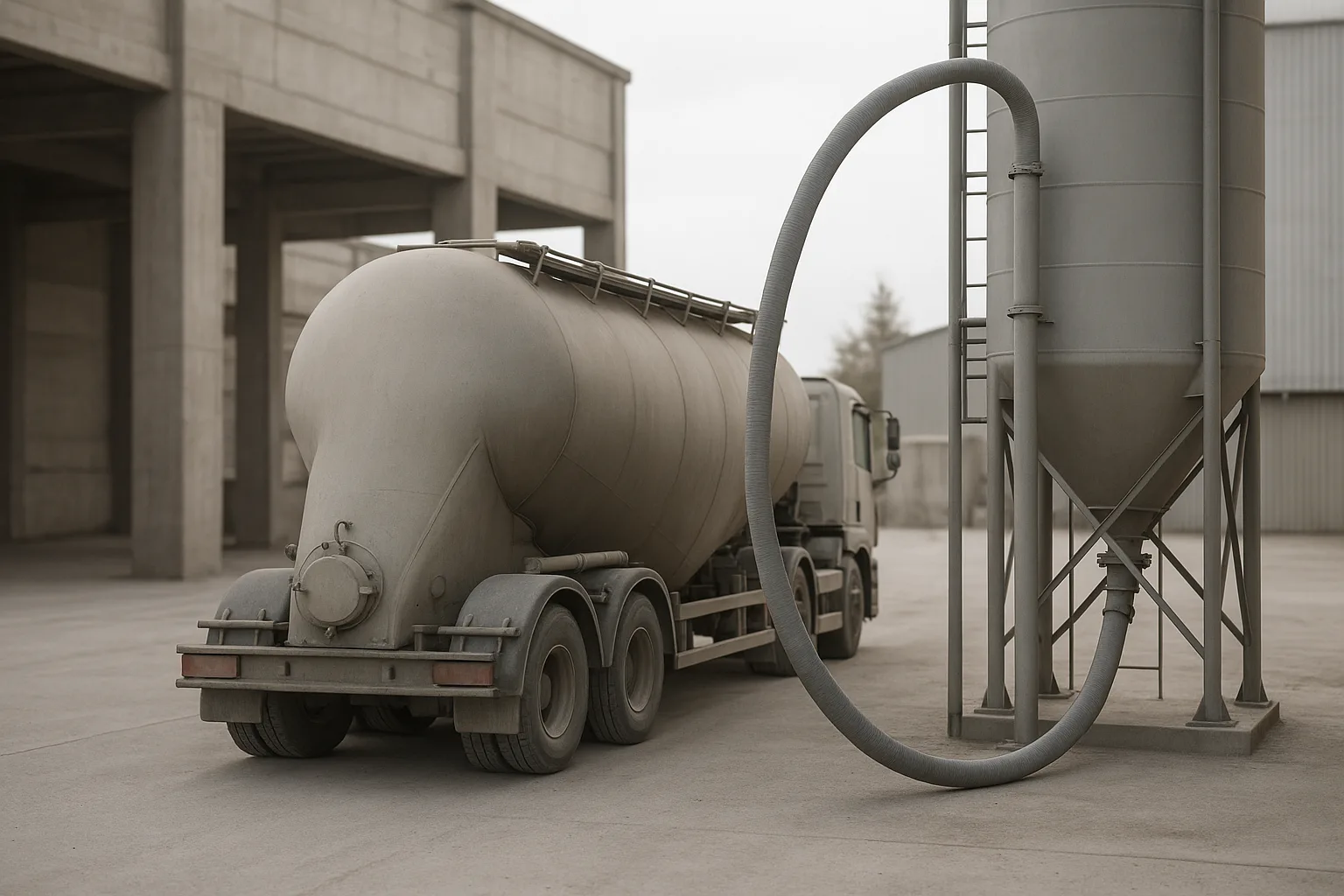
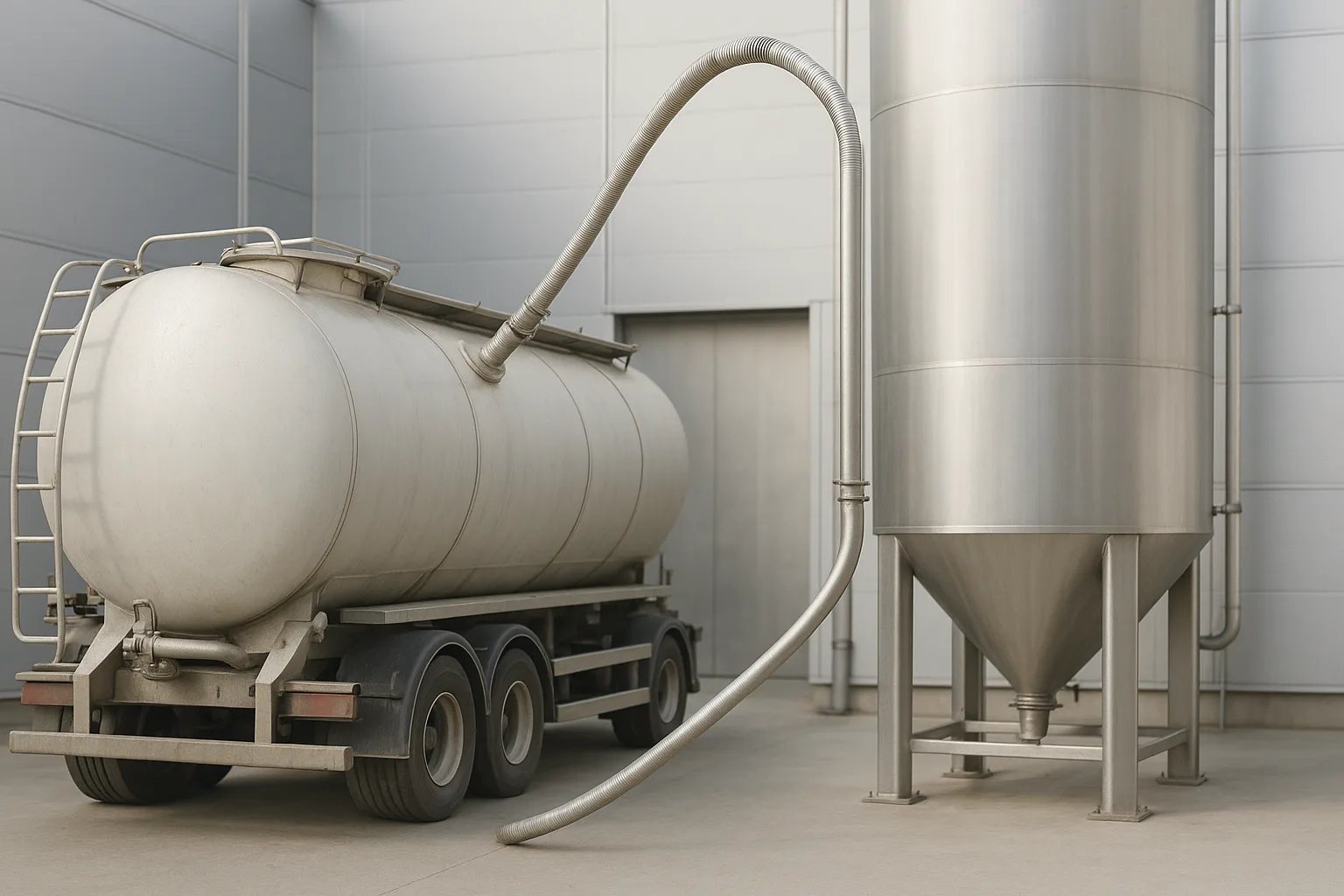
A bulk tanker connected to a single conveying line running up to an outdoor silo.

Application

Pneumatic Conveying in Building Materials Plants

With cement, lime and ash the conveying velocity is the wear bill.

These powders are fine and abrasive, and a dilute phase line at full velocity eats bends within months.

Explore
A bulk tanker connected to a single conveying line running up to an outdoor silo.

Application

Pneumatic Conveying in Food Production

In a food plant the conveying air is an ingredient.

It touches the product over the whole line, so its moisture, oil content and filtration are part of the food safety case rather than a utility specification.

Explore
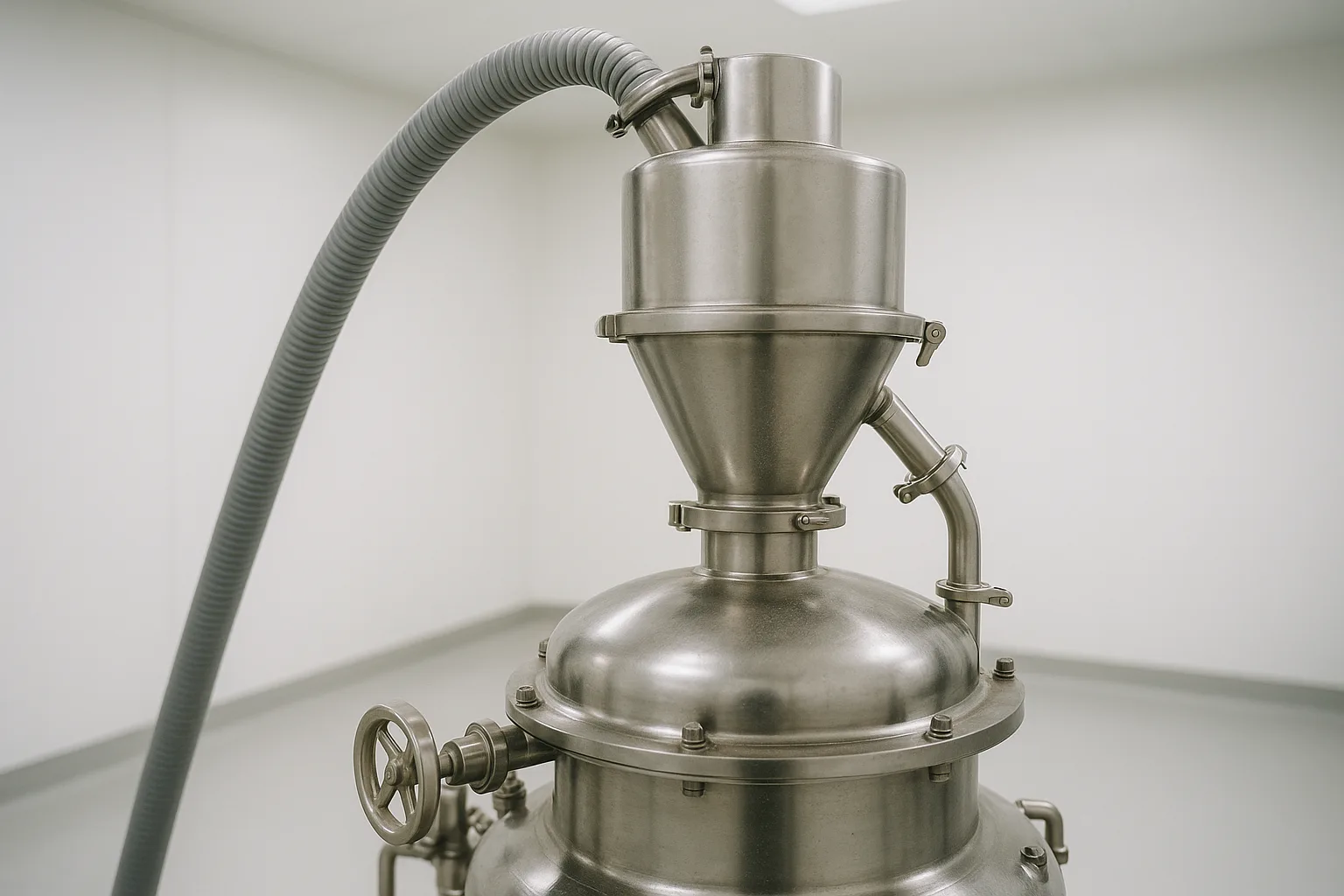
A stainless vacuum receiver mounted on top of a closed process vessel, one flexible suction hose entering it.

Application

Pneumatic Conveying in Pharmaceutical Production

In pharmaceutical production pneumatic transfer means vacuum transfer, for one reason: a vacuum line leaks inward.

A failed seal draws air in rather than releasing product, which is the opposite of what a pressure line does.

Explore
Photorealistic industrial process installation representing Vacuum Conveying.

Application

Polysilicon Powder Reclamation

Polysilicon powder reclamation captures fine silicon-bearing material from defined process sources, moves it without uncontrolled contamination or dust release, and delivers a characterized fraction for approved reuse, recycling or disposal.

Recovered mass counts only when source history, particle size and analytical results support the intended destination.

Explore
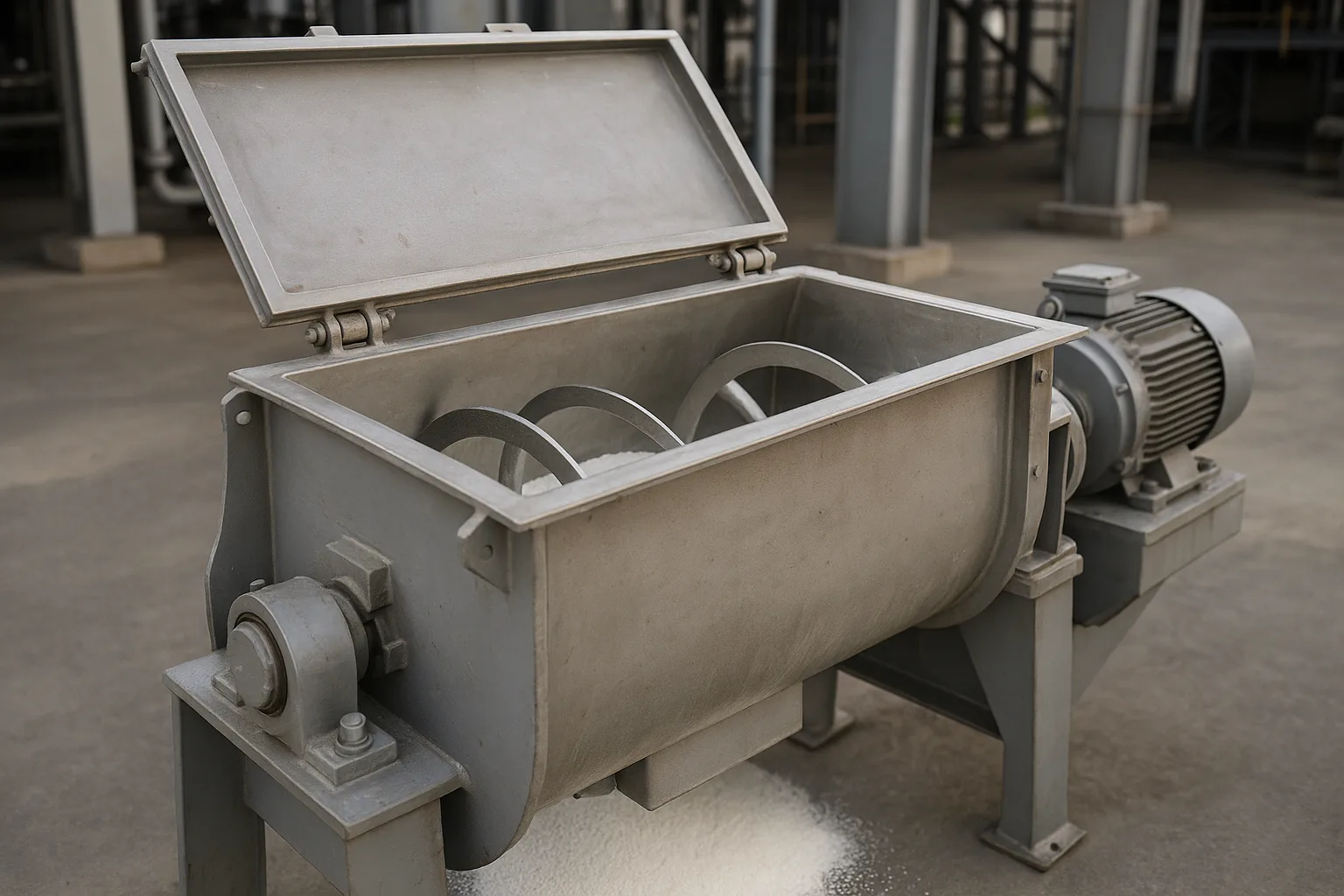
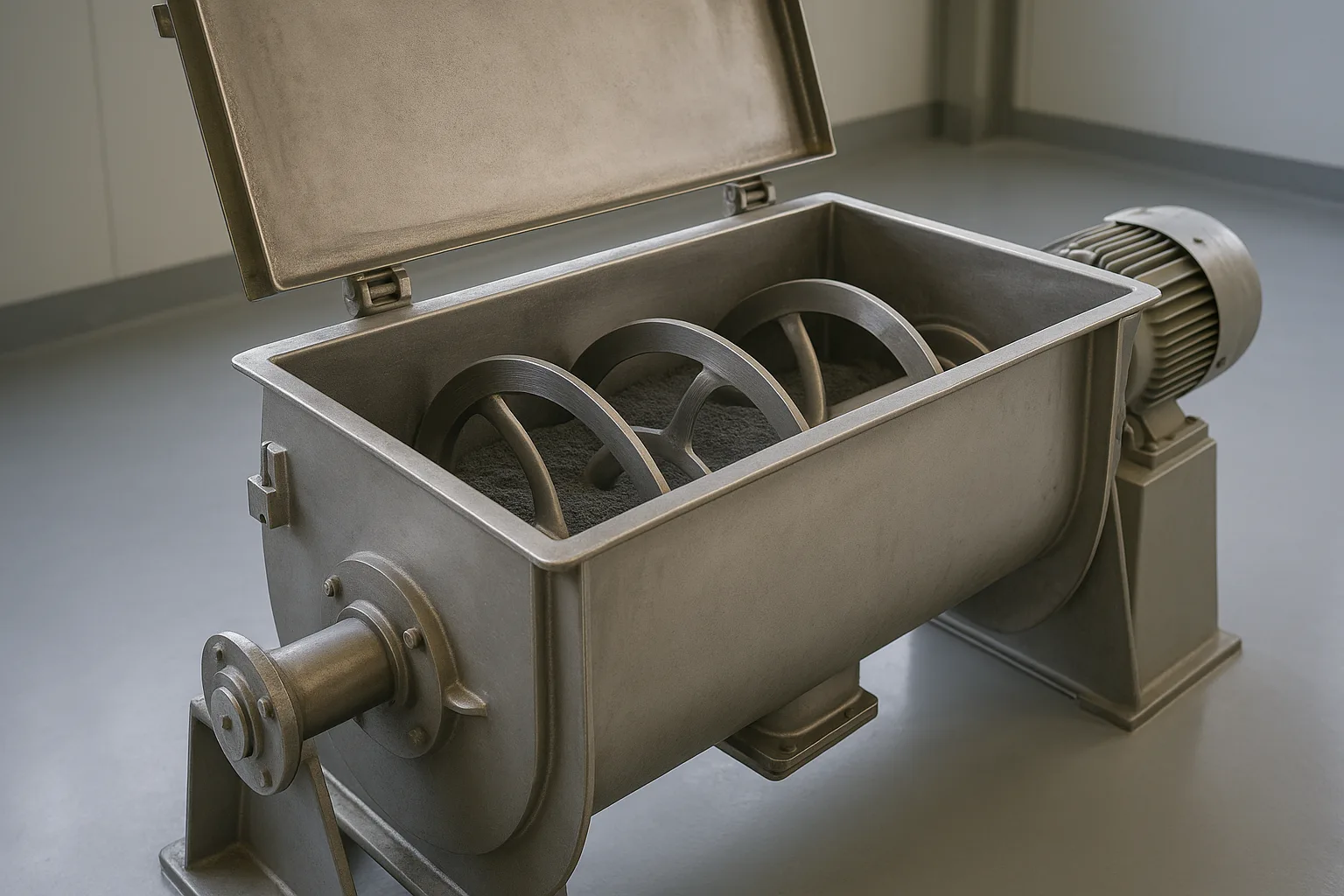
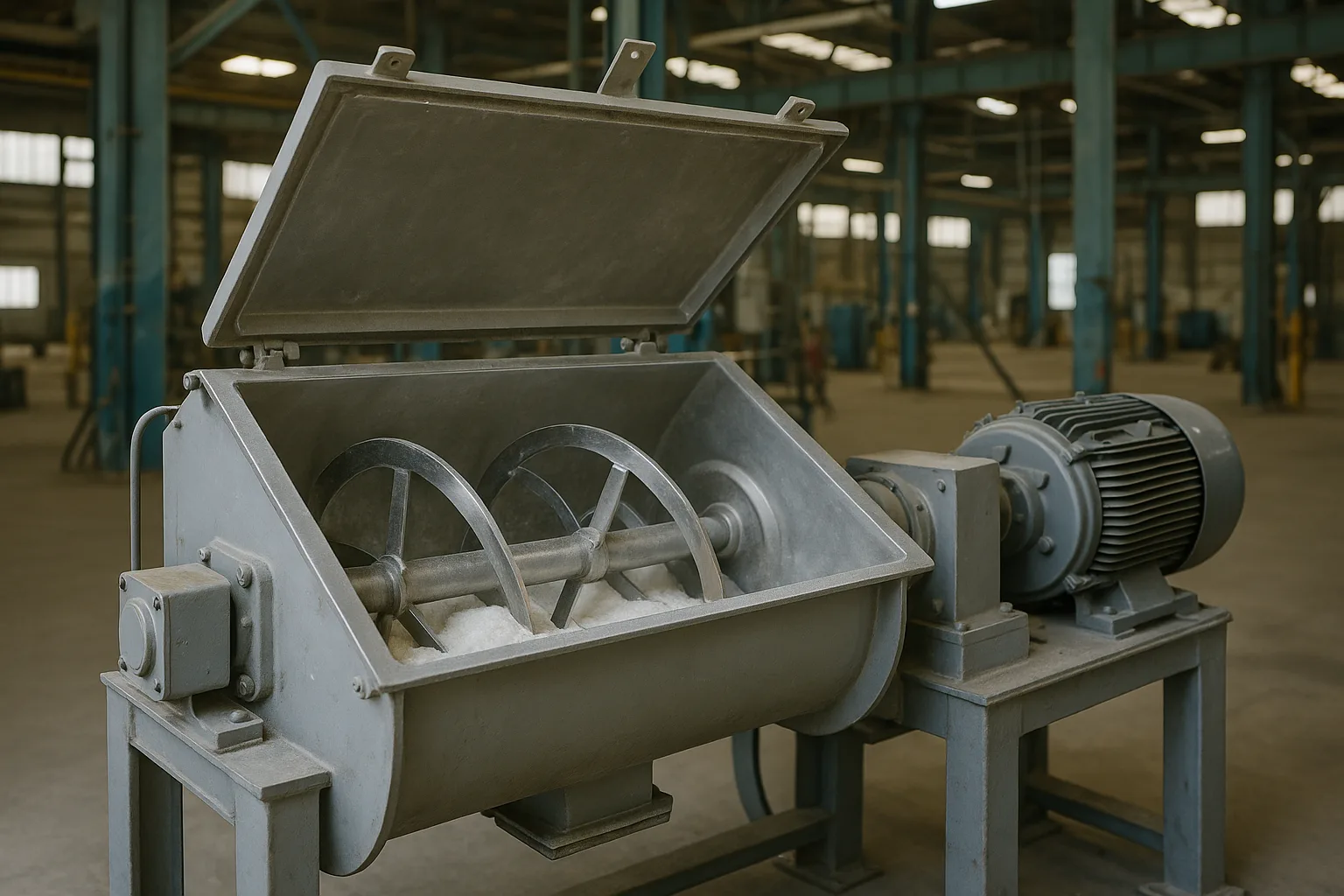
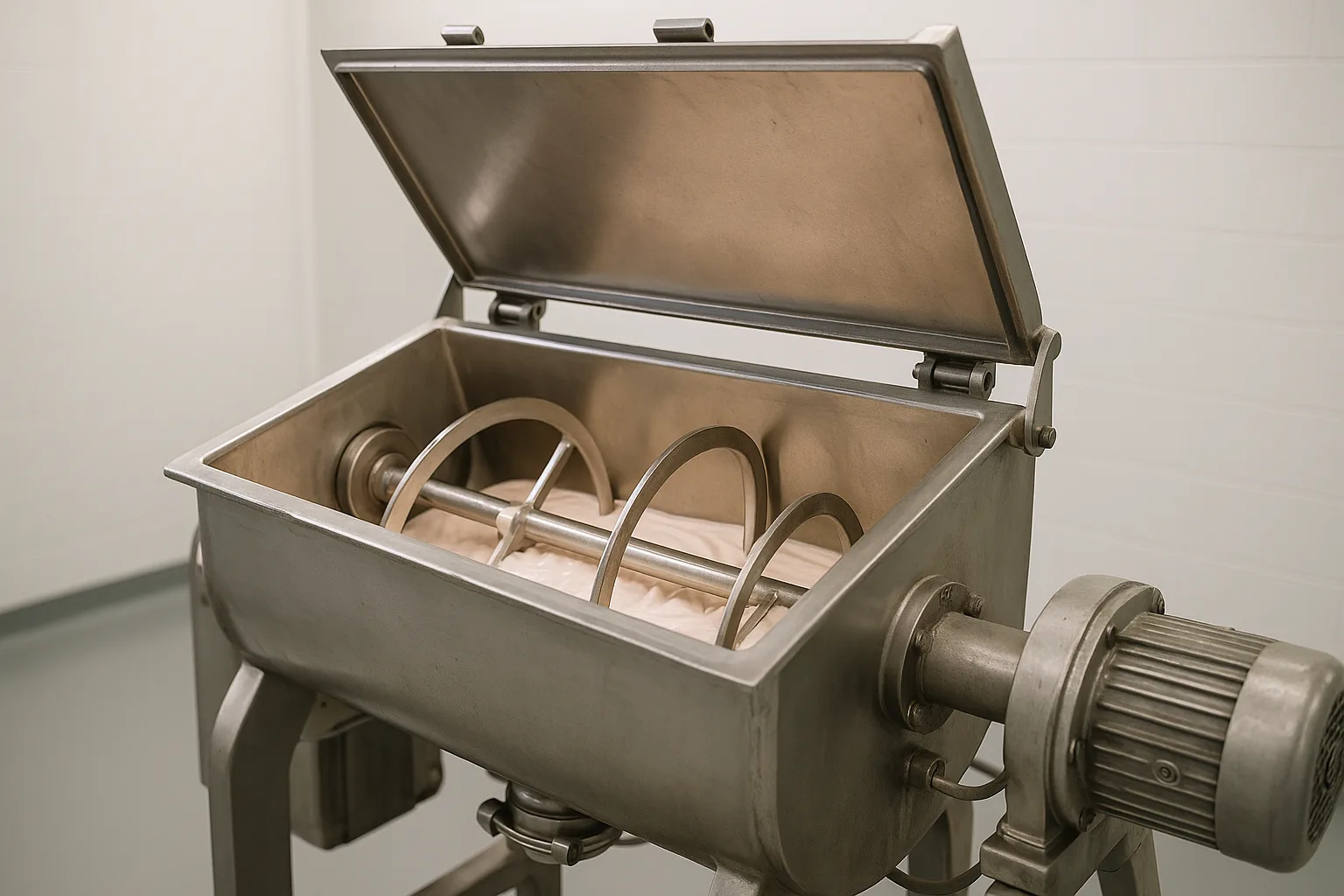
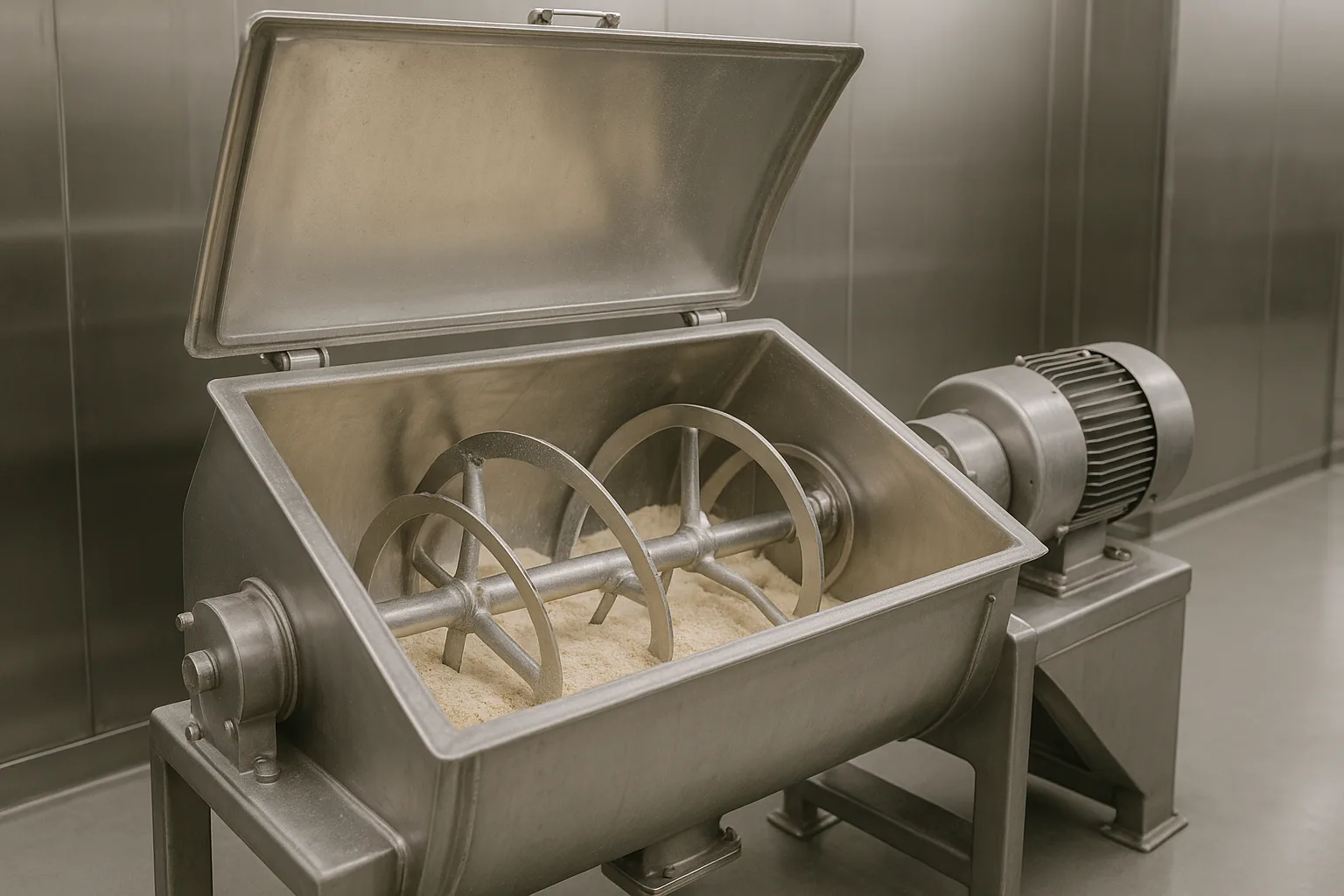
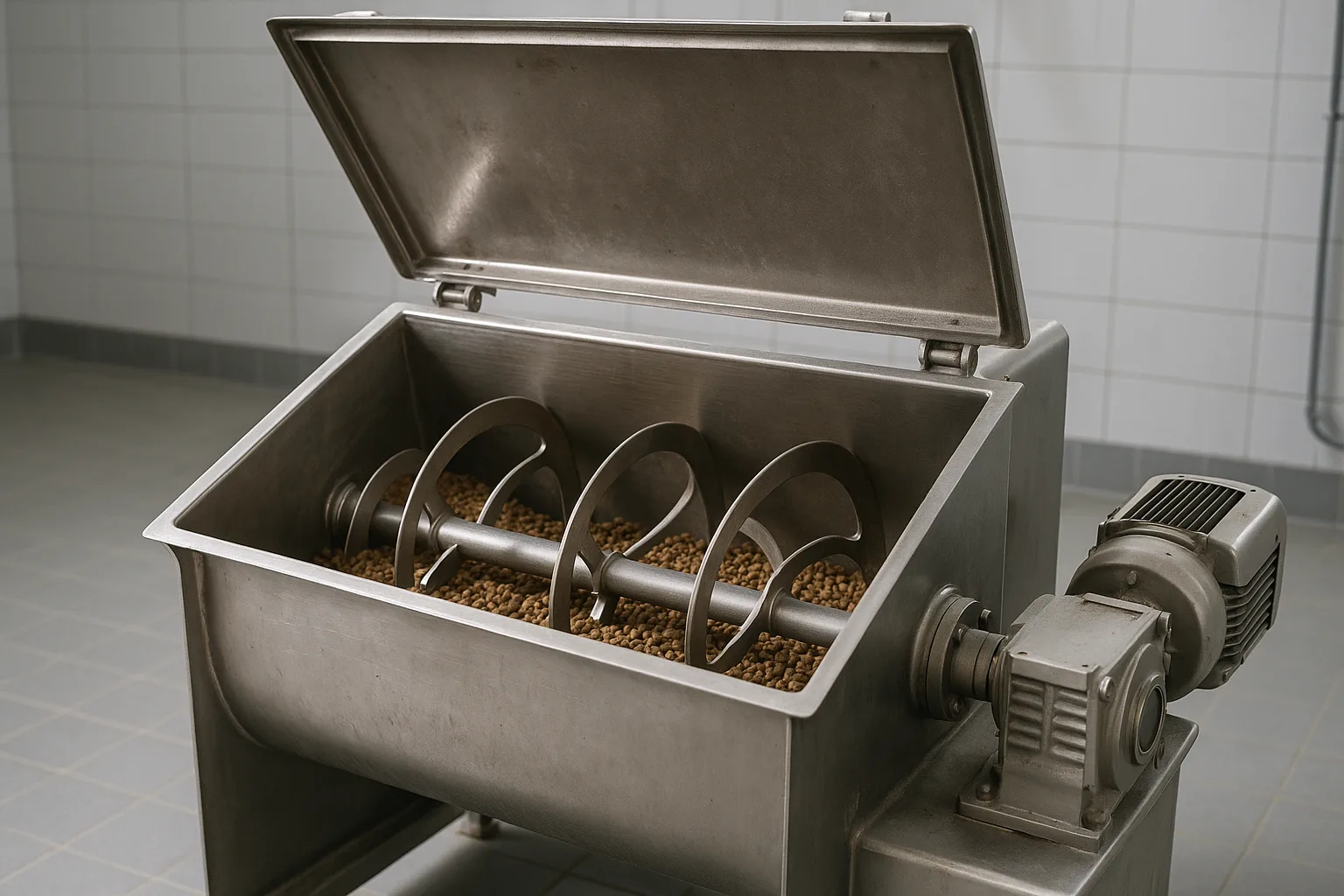
A horizontal ribbon blender with its cover open, product visible in the trough.

Application

Powder Blending for Food and Pharma

Regulated blending stands on three legs: a defined uniformity criterion at the critical ingredient (with pre-blends diluting traces before the main mixer), a blender family chosen for the recipe's fragility and changeover reality, and hygienic execution that makes validated cleaning achievable between batches.

Uniformity proves the blend; cleanability protects the next one.

Explore
A horizontal ribbon blender with its cover open, product visible in the trough.

Application

Powder Blending in Battery Material Production

Battery material blending is judged by homogeneity and by what the mixer adds to the powder.

Wear debris from blades and shell is metallic contamination, and in this industry that is a direct quality loss.

Explore
A horizontal ribbon blender with its cover open, product visible in the trough.

Application

Powder Blending in Chemical Production

Chemical blends mix components that differ widely in density and particle size, which is exactly the recipe for segregation.

The mixer usually achieves the specification; the transfer afterwards is where it is lost.

Explore
A horizontal ribbon blender with its cover open, product visible in the trough.

Application

Powder Blending in Cosmetics Production

In colour cosmetics the blend is judged by eye, which is a stricter test than most analytical limits.

Pigment agglomerates that survive the mixer appear as specks in the pressed product, and carryover between shades is visible immediately.

Explore
A horizontal ribbon blender with its cover open, product visible in the trough.

Application

Powder Blending in Food Production

In food production the blend has to survive the journey to the bag.

Spices, vitamins and colours are dosed at fractions of a percent, and every fall between mixer and filler sorts them out again.

Explore
A horizontal ribbon blender with its cover open, product visible in the trough.

Application

Powder Blending in Pet Food Production

Pet food blends carry vitamins and minerals at very low inclusion, and the animal receives whatever the blend delivered.

Fat addition changes the mixing behavior entirely, and a blend that was uniform dry can separate once it is coated.

Explore

About applications

Why we organise by job

Nobody buys a rotary valve. They buy a way to get flour out of a silo without losing air pressure.

Equipment catalogues are organised by machine, because that is how machines are built and sold. Plants are organised by job, because that is how problems arrive. Somebody has to unload a tanker, feed a press, keep a baghouse from blinding or stop dust escaping at a transfer point.

This section follows the second order. Each page names a job, in a named industry, and works from the duty to the equipment.

The jobs on this site

  • Receiving: tanker unloading, bulk bag discharge, sack tipping, drum emptying.
  • Storage and reclaim: silo discharge, bin activation, flow aids, level and inventory.
  • Transfer: pneumatic conveying in dilute and dense phase, mechanical conveying, routing to several destinations.
  • Dosing and preparation: gravimetric and volumetric feeding, batching, screening, mixing, milling.
  • Protection: dust collection, explosion venting and isolation, containment for potent compounds.
  • Despatch: bagging, big bag filling, truck and ship loading.

What makes a job difficult

The duty is rarely constant

A conveying line sized for the average rate fails at the peak. A feeder sized for the nominal recipe cannot hold tolerance at the smallest addition. The first question on any application page is therefore the range, not the figure: the lowest rate, the highest rate, and how often each occurs.

The machines interact

Most jobs need a chain, and the weakest link decides the result. A vacuum receiver that cannot clean its filter will starve the feeder below it, whatever the feeder is capable of. A silo that bridges makes the discharge equipment irrelevant.

Where a page recommends equipment, it names the interface as well: what has to be true upstream and downstream for the machine to perform as specified.

The industry changes the answer

The same job has different constraints in different industries. Bulk bag discharge in a food plant has to be cleanable and allergen-segregated. In a cement works, the same job is about wear and dust. In pharmaceuticals, it is about containment and validation.

That is why the pages are written by job and industry together, rather than by job alone.

How to use this section

If you know the job, start here and follow the links into the technologies it uses. If you know the material, start from the material pages and arrive at the same place from the other side. If you know the machine, the technology pages are the way in.

Every application page carries the same structure: the problem as operators describe it, the result a good design delivers, how the job is normally arranged, the factors that decide the selection, and the failure modes that show up when one of them was missed.

What these pages do not do

They do not size equipment. Sizing needs measured material properties, the real duty cycle and the plant layout, and it belongs with the supplier who will stand behind the result.

What they do is shorten the distance between a problem and the right question. Most bad installations are not bad machines; they are machines selected against the wrong duty, or installed without the condition that made them work in the reference plant.

How the duty is written down

Most arguments between a plant and a supplier come from a duty that was never written down properly. Five lines prevent them.

  • Material and condition: name, supplier, particle size distribution, moisture range, temperature at the inlet.
  • Rate: average, peak, and the duration of the peak. A line that runs ten minutes at double rate is a different line.
  • Geometry: horizontal distance, vertical lift, number and radius of bends, the position of every destination.
  • Environment: area classification, hygiene standard, washdown, ambient temperature and humidity.
  • Acceptance: what will be measured on handover, and against which tolerance.

Where the limits sit

Conveying velocity

Dilute phase conveying carries material suspended in air and needs a velocity above the saltation point, which for most powders puts it in the range of roughly fifteen to thirty metres per second. Dense phase moves material as slugs at a fraction of that, typically single digits.

The difference is not a preference. High velocity breaks fragile product and erodes bends; low velocity needs more pressure and a vessel rather than a blower. Fragile or abrasive material pushes the choice towards dense phase, long distances and high rates towards dilute.

Feeding accuracy

A volumetric feeder meters a volume and assumes a density. A gravimetric feeder weighs, and therefore holds tolerance when the density changes. Wherever the recipe tolerance is tighter than the density variation of the material, the question is already answered.

Dust capture

Capture happens at the source or it does not happen. Extraction volume follows the open area and the face velocity needed to hold dust in, not the size of the machine, and a hood that is too far away cannot be fixed with a bigger fan.

The failure modes that repeat

Across every job on this site, the same four causes account for most of what goes wrong after commissioning.

  • Sized for the average. The peak rate was known and left out of the specification, so the line runs at its limit every shift.
  • The interface was nobody's scope. Two suppliers each delivered correctly, and the connection between them was designed by neither.
  • The material changed. A new supplier, a finer grade or a wetter season moved a property that the design depended on.
  • Cleaning was an afterthought. The equipment performs and cannot be cleaned in the time the plant has, so it is opened less often than it should be.

None of these is exotic, and all four are cheap to prevent at the specification stage and expensive to fix afterwards. Each application page names the ones that apply to that job.

Frequently asked questions

What is the difference between an application and a technology page?
A technology page describes a class of machine and how it is selected. An application page describes a job in a named industry and which machines, together, solve it. The same technology appears in many applications.
Why is the same job split by industry?
Because the constraints differ. Bulk bag discharge in food production is a hygiene and allergen problem, in a cement works a wear and dust problem, in pharmaceuticals a containment problem. One page per combination keeps each answer specific.
Can these pages replace a supplier's sizing?
No. They name the duty questions and the decisive properties. Sizing requires measured material data and the real duty cycle, and it belongs with the supplier who warrants the performance.

Partner with powderbulkvideos.com

Put your technical expertise in front of engineers who are already researching.

Build a connected company, video and technology presence with clearly labelled partner visibility and measurable placement performance.