
Material
Metal Powders for Additive Manufacturing
Answer in brief
With AM powder the handling system is part of the material specification.
Spherical, free-flowing powder prints well, and everything in the plant either preserves that condition or quietly destroys it through oxygen pickup, moisture and satellite formation.
- Handle under inert gas wherever the powder is exposed.
- Sieve and track every reuse cycle rather than mixing batches by feel.
- Treat fine aluminium and titanium powder as a serious explosion and fire hazard.
Reviewed October 21, 2026 · Updated November 10, 2026
Handling challenges
In additive manufacturing the powder is not an input to the process, it is most of the process.
Flowability, particle size distribution and oxygen content decide whether a layer spreads evenly, and all three change with handling.
Reactivity is the first constraint
Fine titanium and aluminium powders ignite readily, burn at high temperature and react with water, which rules out standard firefighting.
Closed, inerted transfer with controlled oxygen monitoring is the normal design, and conductive, grounded components are mandatory rather than advisable.
Vacuum conveying under inert gas keeps both the operator and the powder out of contact with air.
Protecting powder quality
Each reuse cycle adds oxygen, removes the finest fraction and adds spatter particles from the build chamber.
- Sieve after every build to remove agglomerates and spatter.
- Track cycle count per batch and blend to a defined rule rather than by availability.
- Store under inert gas or controlled dew point, since moisture pickup is fast at these particle sizes.
Operator exposure
Nickel and cobalt-bearing alloy powders carry real occupational exposure limits, and the particle size means deep lung deposition.
Glovebox or contained docking arrangements for machine loading and unloading are chosen for exposure control as much as for powder quality.
Traceability
Aerospace and medical users expect batch-level traceability from the powder lot through every build.
That requirement shapes the handling system: dedicated lines per alloy, documented cleaning between alloys and a records trail that survives an audit.
What to establish before buying equipment
- Alloy list and whether shared equipment is acceptable at all.
- Permissible oxygen and moisture pickup across the handling chain.
- Explosion characteristics of the specific powder, including the fines.
- Reuse policy and the sieving cut that supports it.
Storage and conditioning
Metal powder for additive manufacturing is stored for its properties, not just its quantity.
Spherical particles and a controlled size distribution are what make a powder printable, and both degrade with handling and with moisture. Oxygen and water pick-up change the chemistry at the particle surface, which shows up later as porosity in a part.
- Store under an inert atmosphere or with controlled humidity, depending on the alloy.
- Track batches: powder is reused, and reuse history is part of its specification.
- Keep containers sealed; this is a chemistry problem long before it is a handling problem.
What this means for equipment
Two requirements dominate and they pull in the same direction: preserve the particles and contain them.
Gentle, closed transfer with inert gas where the alloy needs it. Sieving is part of the loop rather than an extra step, because every print cycle changes the distribution.
- Closed transfer with valve-to-valve connections.
- Inerted handling for reactive alloys such as aluminium and titanium.
- Integrated sieving with a defined cut, documented per batch.
Cross-contamination between alloys is the quiet failure: a trace of one powder in another is invisible and ruins parts.
Safety and regulatory
Fine metal powders are among the most severe dust explosion hazards in industry.
Aluminium and titanium powders in particular reach high deflagration indices and have low ignition energies, and burning metal cannot be extinguished with water or with ordinary extinguishers.
- Inerting where the alloy requires it, with oxygen monitoring.
- Earthing and bonding throughout; static is a credible ignition source.
- Class D extinguishing media available and the response trained.
The inhalation hazard is separate and real: these are fine particles in the respirable range, and some alloys contain regulated elements.
Material behavior
- Flowability
- Excellent when spherical and dry
- Abrasiveness
- Moderate
- Cohesiveness
- Low when dry, rises sharply with moisture
- Moisture behavior
- Moisture degrades flow and causes porosity in printed parts
- Contamination risk
- Cross-contamination between alloys makes a batch unusable
Partner with powderbulkvideos.com
Put a relevant technical solution in this decision path.
Connect your company and video evidence with clearly labelled visibility where engineers evaluate this material, application, industry or product.
Frequently asked questions
Why does powder reuse have to be tracked?
Because every print cycle changes the particle size distribution and the surface chemistry. The reuse history is part of the material specification, not an administrative detail.
Which alloys need inerting?
Reactive ones, aluminium and titanium above all. They combine a low ignition energy with a high deflagration index, and burning metal cannot be put out with water.
What is the biggest quality risk in handling?
Cross-contamination between alloys. A trace of one powder in another is invisible in the container and shows up as a failed part.
Related content
Continue exploring
Move from this page to the companies, videos and technical topics that add useful context.
Companies
Videos
Volkmann GmbH
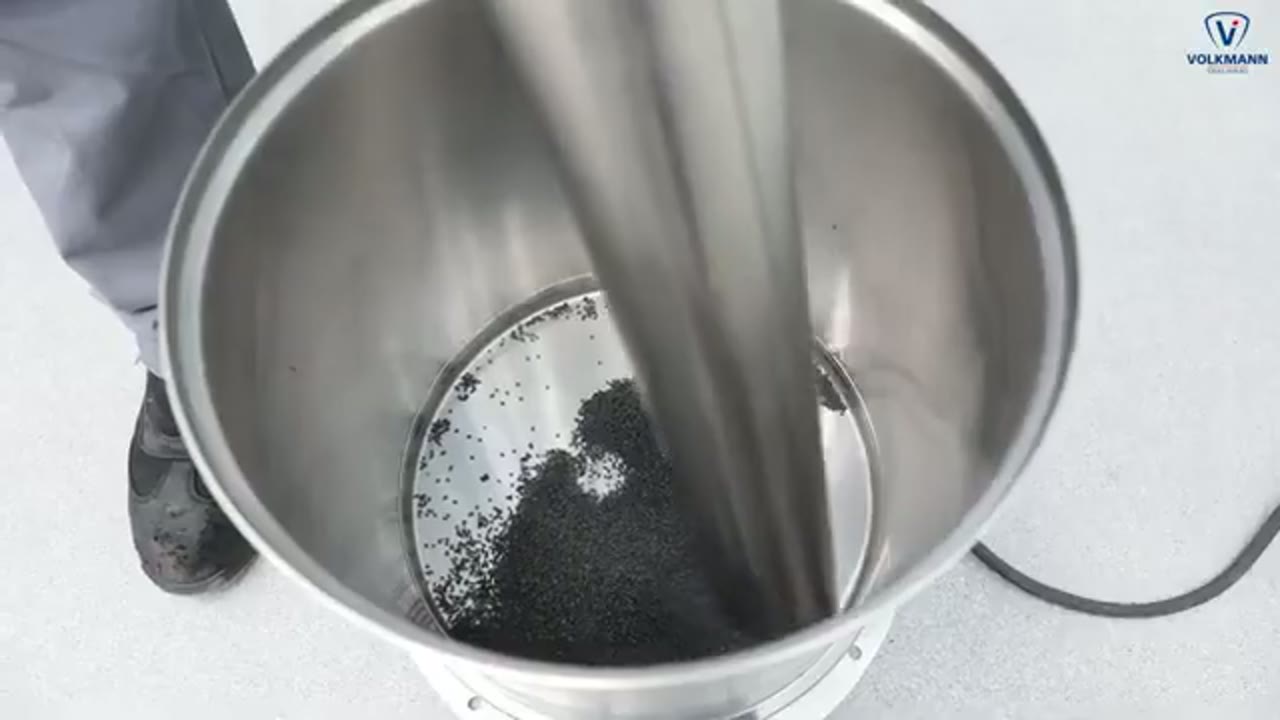
Suction lance for powder feeding
The Volkmann video shows powder being introduced from a drum or container through a suction lance into a vacuum conveying line. It shows the pickup boundary and the need to admit material and conveying air in a controlled way. Capacity and suitability depend on the powder and need a conveying trial with the actual material.
Total reach: 1,929

Volkmann GmbH
VOLKMANN: Additive Manufacturing Powder Handling
Official Volkmann GmbH video on closed transfer, recovery, and reuse of additive-manufacturing powders, presented as one connected workflow from powder receipt to its return into a controlled process.
Total reach: 4,860