
Material
Pharmaceutical Tablets
Answer in brief
A tablet is a finished product from the moment it leaves the press, so every later transfer can only subtract value.
Chipping, capping and attrition show up as rejected batches and as dust that has to be captured before coating or packaging.
- Minimize drop heights and use spiral let-downs instead of vertical chutes.
- Deduct and dedust immediately after the press, not before packaging.
- Keep batch identity physically separated, because a mix-up is a recall.
Reviewed October 21, 2026 · Updated November 10, 2026
Handling challenges
Tablet handling is less about moving a bulk solid and more about protecting a finished dosage form that has to arrive intact, clean and unambiguously identified.
Mechanical damage between press and blister
Chipping and edge wear come from impact and from tablet-on-tablet abrasion in long chutes.
- Spiral let-down tubes rather than straight vertical drops.
- Short, gently inclined transfers with no abrupt changes of direction.
- Controlled bed depth in containers, since weight on the lowest layer is itself a load.
Friability testing of the specific formulation tells you how much transfer the tablet can take, and that number should drive the layout rather than the available floor space.
Dedusting and dust removal
Fines released at the press stick to tablet surfaces and interfere with coating adhesion and with print quality.
Dedusters and metal detection sit directly after the press for that reason, and the extracted dust is product that may need reconciliation in the batch record.
Containment for potent compounds
Where the active ingredient is highly potent, the handling question changes from product protection to operator protection.
Contained transfer, split butterfly valves and closed sampling keep exposure within the occupational band assigned to the compound, and the containment performance has to be demonstrated rather than assumed.
Traceability and mix-up prevention
Physical segregation is the only robust defense against a mix-up: one product in one line, one batch in one container, with labelling applied before the container leaves the room.
Cleaning between products needs a documented and verified procedure, and the verification is swabbing and analysis rather than a visual check.
Dust explosion and static
Tablet dust and the granulate it comes from are combustible, and dry transfer generates static readily.
Equipotential bonding, grounded conductive components and controlled relative humidity are the usual measures, with collector protection assessed separately.
What to establish before buying equipment
- Friability and hardness of the real tablet, including the coated form.
- Occupational exposure band of the active ingredient.
- Required cleaning validation approach and changeover time.
- Humidity window for core and coating stability.
Storage and conditioning
Tablets are a finished dosage form, so storage is about protecting a product that cannot be reworked.
They chip and abrade against each other, they take up moisture through the coating, and every unit is accountable. A broken tablet is not a yield loss in the usual sense; it is a deviation.
- Control humidity and temperature to the product specification, not to a general warehouse standard.
- Keep bed depths shallow; tablets at the bottom of a deep container carry the weight of everything above.
- Maintain batch segregation physically, not only by label.
What this means for equipment
Gentleness and traceability set the equipment.
Every transfer chips edges and generates dust, and tablet dust is both a loss and a cross-contamination risk. Vacuum transfer at low velocity with soft-landing receivers is the usual approach, and deduster and metal detection sit directly after the press.
- Low-velocity closed transfer with decelerating receivers.
- Dedusting immediately after the press, where the dust belongs to one product.
- Cleaning validation on every contact surface between products.
Safety and regulatory
The dust is combustible and the main controls are containment and cross-contamination.
- Containment appropriate to the active ingredient, not to the tablet as an object.
- Explosion protection where dust accumulates, from measured values.
- Cleaning and changeover procedures that are validated, not merely documented.
Material behavior
- Flowability
- Good, but shape dependent
- Abrasiveness
- Low
- Cohesiveness
- Low; static can cause clumping
- Moisture behavior
- Coating and core sensitive to humidity
- Contamination risk
- Cross-contamination between products and potent compound exposure
Partner with powderbulkvideos.com
Put a relevant technical solution in this decision path.
Connect your company and video evidence with clearly labelled visibility where engineers evaluate this material, application, industry or product.
Frequently asked questions
Why is tablet dust a problem?
It is a loss and a cross-contamination risk at the same time. Dedusting immediately after the press keeps the dust with the product it came from.
Can tablets be conveyed pneumatically?
At low velocity in a closed system with decelerating receivers, yes. High velocity chips edges and generates exactly the dust the line is trying to avoid.
What drives the containment requirement?
The active ingredient, not the dosage form. A tablet containing a potent compound needs the containment of that compound.
Related content
Continue exploring
Move from this page to the companies, videos and technical topics that add useful context.
Companies

Videos

Gericke AG
Gericke: GFS Formulation Skid and Tablet Press
This video presents the Gericke Formulation Skid (GFS) combined with a tablet press, showing how pharmaceutical formulations move from blending through downstream processing in one controlled, scalable setup. The system runs semi-continuously or fully continuously and targets development, scale-up, and technology transfer.
Total reach: 3,834
GEA
ConsiGma Continuous Granulation and Compression Line
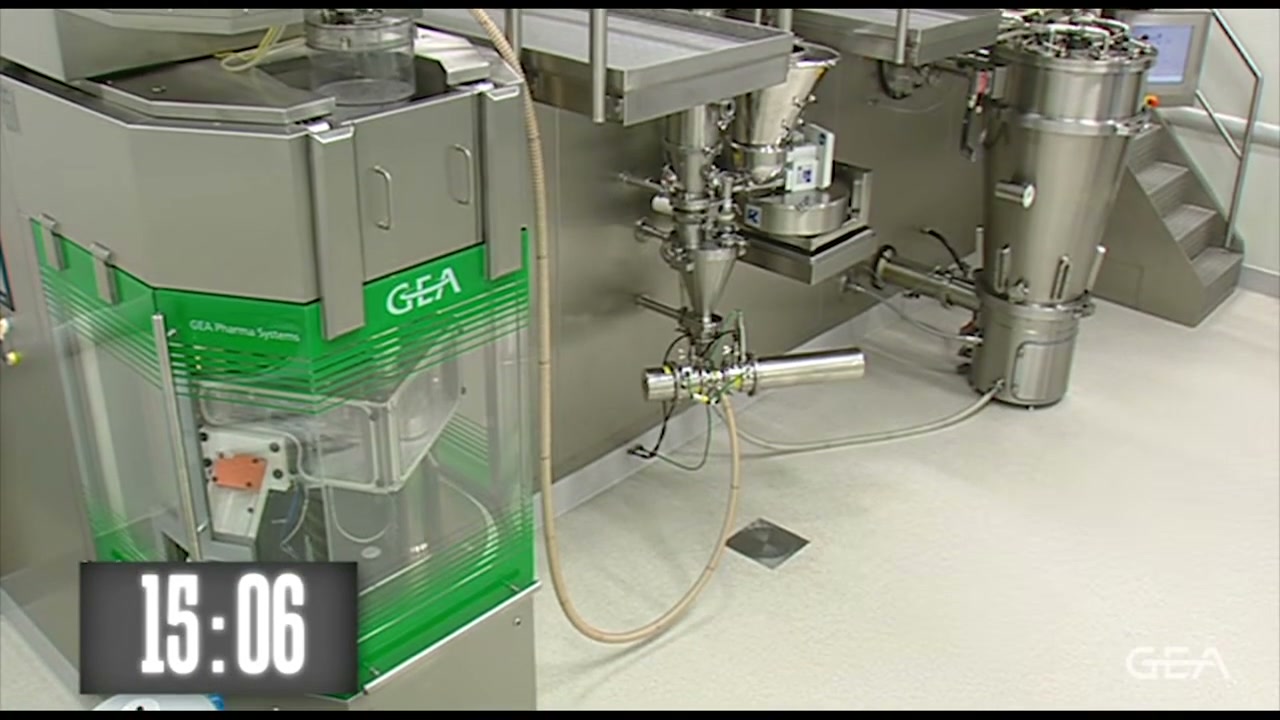
GEA explains the working principle of a continuous granulation and compression line, the section of a continuous tableting plant between the feeders and the tablet press.
Glatt
MODCOS Direct Compression
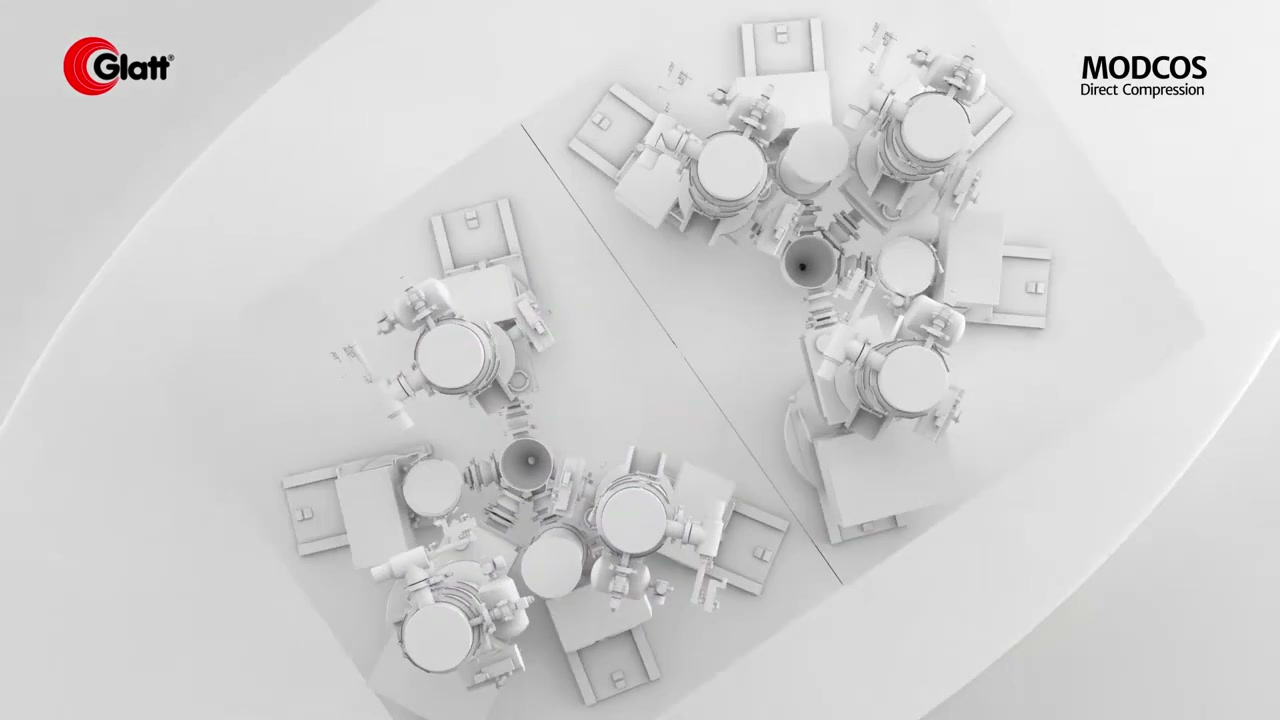
Glatt shows the MODCOS line for continuous direct compression, which can integrate up to three mixers and ten feeders on the way from powder to tablet.
Total reach: 2,668