
Application
Gravimetric Feeding in Chemical Processing
Answer in brief
In chemical processing the feeder has to be compatible before it can be accurate.
Corrosive, abrasive and hygroscopic powders attack the screw, the hopper and the seals, and a machine that is losing material to wear is not holding a rate either.
- Fix compatibility and the area classification first.
- Design for the full bulk density range, aerated and settled.
- Keep the weighing free of pipe forces and pressure differences.
Reviewed October 21, 2026
The problem
A chemical plant feeds a wide variety of powders into reactors, dryers and blending vessels, and the list usually includes something hostile: a corrosive salt, an abrasive mineral filler, a hygroscopic powder that cakes on contact with humid air, or a product that is harmful enough that leakage is an exposure event.
Compatibility therefore comes before accuracy, and not only for the obvious parts. Screws, hopper walls, flexible sections, shaft seals and the lubricant all see the material, and so does whatever is used to clean between campaigns.
The bulk density range is the second recurring problem. Many chemical powders change density by a large factor between the aerated state after conveying and the settled state after standing, and a volumetric device cannot cope with that at all. Gravimetric control can, but only inside the turndown of the discharge device.
Then there is the installation. Feeders in chemical plants are frequently connected to pressurised or evacuated equipment, and a pressure difference across the feeder outlet applies a force the load cells report as mass.
Desired outcome
A feeder whose wetted parts are verified against every product and cleaning agent in the campaign plan, at temperature, with wear parts identified and stocked.
Accuracy held across the full bulk density range, with the discharge device sized so the required turndown sits inside its usable range.
A weighing installation free of transmitted pipe forces and pressure effects, and an assembly certified for the area it stands in.
A cosmetics line is decided by the smallest pigment rate and by shade tolerance, where a feeder sized to look proportionate to the mixer is already wrong.
Process approach
The compatibility matrix is built first: products, temperatures, cleaning agents, and every wetted component including seals and lubricants. This step frequently decides the machine, because the choice between a stainless screw, a coated one and a polymer lined hopper is made here rather than on performance.
The density range is then established by measurement, aerated and settled, because that range sets the required turndown. Where it is wide, the answer is often a larger screw turning slower rather than a smaller one at the top of its range, and sometimes two feeders rather than one.
The outlet connection is designed for the pressure it will see. A feeder discharging into a vessel under vacuum or under pressure needs a vent or a pressure compensation arrangement, otherwise the differential across the flexible connection appears directly in the weight signal and drifts with process conditions.
Area classification is applied to the complete assembly: drive, load cells, junction boxes and local control. And where the powder is harmful, the refill and cleaning operations are designed as containment tasks with extraction at the point of work.
- Compatibility matrix across products, temperatures and cleaning agents, for every wetted part.
- Bulk density range measured aerated and settled, and used to set the required turndown.
- Discharge device sized so the duty sits inside its usable range, not at the top of it.
- Outlet vented or pressure compensated where the receiving vessel is not at ambient.
- Complete assembly certified for the area, instruments and junction boxes included.
- Refill and cleaning designed as containment tasks where the powder is harmful.
Selection factors
- Chemical compatibility of screws, hopper, seals and lubricants with products and cleaning agents.
- Bulk density range between aerated and settled, which sets the turndown requirement.
- Abrasiveness, which decides wear parts and the interval at which the feed factor shifts.
- Receiving vessel pressure, which decides whether venting or compensation is needed.
- Area classification for the whole assembly.
- Exposure limit of the powders, which sets the containment requirement at refill and cleaning.
Common failure modes
- Seals and lubricant qualified against the product but not against the cleaning agent
- Feeder sized at the top of its range, leaving no turndown for the aerated density case
- Outlet connected to a vessel under vacuum with no vent, so the weight signal drifts with process pressure
- Load cell junction box not rated for the classified area the feeder stands in
- Abrasive wear shifting the feed factor with no scheduled check of the screw
- Harmful powder refilled by opening the hopper lid, with containment addressed nowhere
Partner with powderbulkvideos.com
Put a relevant technical solution in this decision path.
Connect your company and video evidence with clearly labelled visibility where engineers evaluate this material, application, industry or product.
Frequently asked questions
What usually decides the machine in chemical service?
Compatibility rather than performance. Once the wetted parts, seals and lubricants are matched to the products and the cleaning agents, the choice of feeder is often already narrow.
Why does bulk density range matter so much?
Because it sets the turndown the discharge device has to cover. A powder that doubles in density between aerated and settled asks the screw to work across a range a top of range selection cannot deliver.
How does process pressure affect a feeder?
A pressure difference across the outlet connection applies a force to the weighed assembly, and the controller reads force as mass. Venting or pressure compensation removes it; filtering does not.
Related content
Continue exploring
Move from this page to the companies, videos and technical topics that add useful context.
Companies
Videos


Gericke AG
Gericke: GFS Formulation Skid and Tablet Press
This video presents the Gericke Formulation Skid (GFS) combined with a tablet press, showing how pharmaceutical formulations move from blending through downstream processing in one controlled, scalable setup. The system runs semi-continuously or fully continuously and targets development, scale-up, and technology transfer.
Total reach: 3,835

WAMGROUP
Tubular Screw Conveyors and Feeders
WAMGROUP presents enclosed tubular screw conveyors and feeders used to transfer or meter powders and bulk solids.
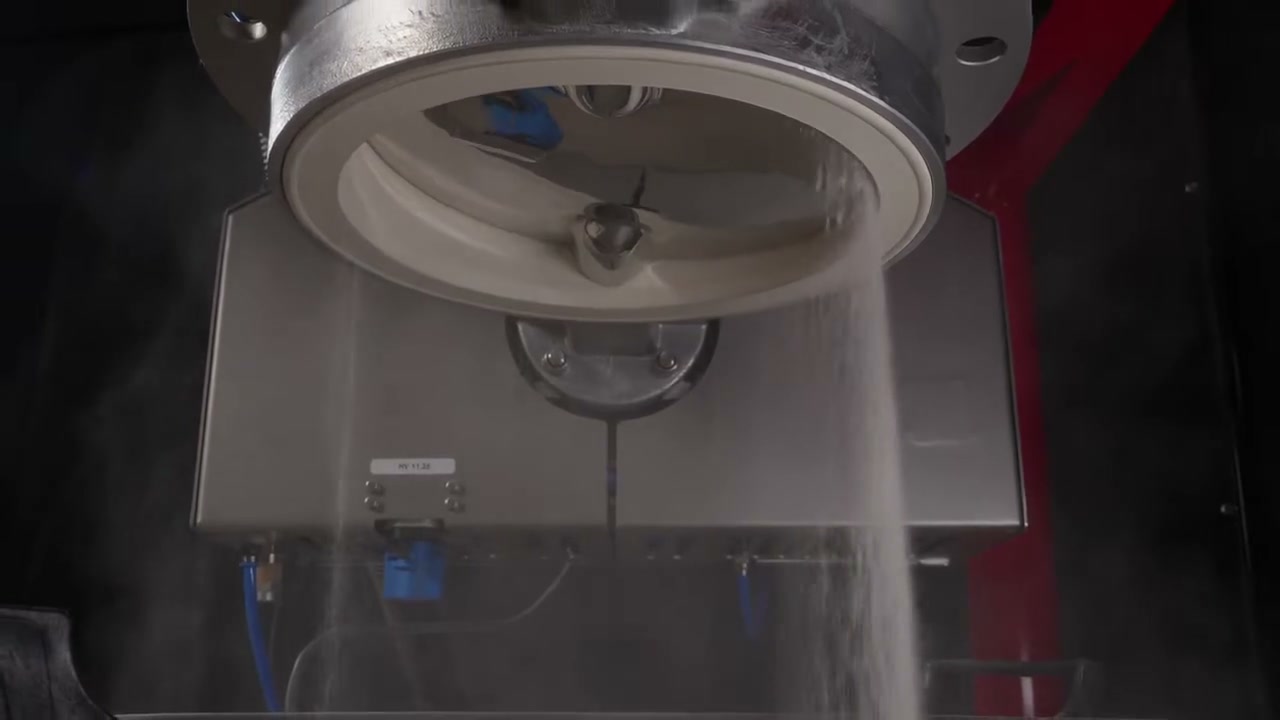
Dinnissen
Feeder Valve
Dinnissen Process Technology shows a feeder valve developed for powder dosing at an accuracy that the older generation of equipment could not reach.